Stone Leech
Large, difficult to kill, and long lived, this creature is responsible for the return of the Dagger as the primary tool of political intrigue.
Full Description
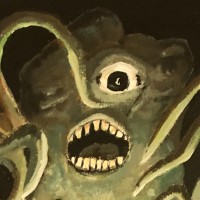
This creature lives in the dark southern jungles, but has found its way to the civilised north. Often hiding in fruit trees or on shrubs favoured by local fauna, it bites its host, injecting a strong paralytic poison, and finds a good spot to stay attached for years, which its host often survives. (Note that it is mindless, and acts only by instinct.)
The size of a woman's hand, it has a hard carapace (hence its name in some parts), and is still harder to remove. It feeds mainly on the host's blood plasma, and though it does weaken its host, it doesn't kill him. It returns what it does not consume.
What's more, it filters its host's blood, removing unusual chemicals, making the wearer in a way immune to poison (or at least helps to recover faster). The natives use it mostly for their shaman, that have to consume strange things to get into contact with the spirits, etc.
Additional Information
More use was found in the civilised north; where there is politicking and treachery, and poisoning quite common. Some noble men and their advisors, and especially their food tasters have chosen to be hosts for the leech... and there is yet a poison to be found against it. Only a few fast poisons are able to kill the host, if lucky. Thanks to the leech, the good old dagger is coming back into fashion.




Not Registered Yet? No problem.
Do you want Strolenati super powers? Registering. That's how you get super powers! These are just a couple powers you receive with more to come as you participate.
- Upvote and give XP to encourage useful comments.
- Work on submissions in private or flag them for assistance.
- Earn XP and gain levels that give you more site abilities (super powers).
- You should register. All your friends are doing it!
? Responses (7)

How much paralytic poison is needed and what does it do to the host?
So where do people wear this lump?
Thinking of poisonous creatures, you don't need much of poison to knock out (or kill...) a human. Effect is outright paralysis/unconsciousness or a heavy clouding of mind.
But it provokes an alternative: the toxin could be only numbing. The still tiny leech simply crawls onto a fitting place, the groggy host not feeling him. A fitting place could be one that does not undergo much movement like the limbs where often lands first - typically the upper body. The most likely place where it is hard to discover (and remove) is the back.
In the civilised north, good places to hide it would be again the back (could even help against a dagger!) or the belly. You don't want to show this publicly, do you?
I like the idea of a parasite being used by nobles for advantage. Why did it evolve to look like stone if it is from a jungle and lives in trees?
Sorry, more precise: it does not look like a stone, it is hard as stone (well not that hard, but very hard still). The name is more an appreciation of the diffilcut removal.
As for appearence, an extra touch could be a slow change of colour to resemble the skin of the host... actually, given time, it could even grow into the host, making it impossible to remove without much blood loss.
This is a neat critter!
Update: Added parasite freetext.