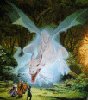
In a cold, unforgiving and brutal world the people need their legends to be told around the fireplace. They need heroes both strong and mighty who can oppose the forces that be and prove that sometimes justice do prevail. On occasion these legends get real, as flesh and blood heroes journey through the lands and show the populace that miracles can happen, heroism does exist. When these heroes face grievous perils whilst defending the population against a greater evil, it may happen that the peasants begin to pray for the safety of their heroic benefactors.
In cottages and farmhouses across the land small candles are lit, figurines are carved in the resemblance of the heroes. Farmers hands shake nervously and are folded; prayers of hope and protection are whispered, and blessings are uttered. Prayer beads are given to the avatars of the peoples hope; the heroic benefactors. Tears of joy are shed when tales of the benefactors latest victory is told and wailing and great lamentation can be heard if such a hero should perish. With time the benefactors embody the dreams, desires and hope of the population, and as entire nations pray for the safety of an individual, ancient magic awakens; remnants of Prime Creation which the Gods could not undo or could not perceive. Under these circumstances a hero might discover that his abilities improve drastically, his perception of the world is altered. He may witness things hitherto unseen; he may experience weird and unexplainable events, and it might come to be that he fears for his very sanity. It feels like he can sense the spirit of a tree; like he can even spy lost souls as they dazedly and nervously search for a path to the afterlife. The hero has ascended, has become a saint, and abilities and feats beyond what mere mortals can achieve are now at his disposal.
Ascension after the hero’s demise
When a beloved hero dies tragically and the populace vehemently mourn his passing, he may ascend. His soul will return from the afterlife as a spirit and a force of nature. As such a spirit he can choose to occupy an avatar by possessing an unfortunate individual. He may also opt to remain a spirit, some kind of ghost, and travel the land, drawn to those praying and calling upon his name, beckoning him into their service. These Saints depend upon their followers and the more popular Saints have greater powers than those who have slipped into oblivion, and have become forgotten long ago.
Ascension while the hero is alive
In rare cases a hero becomes so loved by the people, so utterly praised that it borders on worship. Gradually his senses will develop, become more and more acute and his skills will grow with unprecedented speed. New abilities such as supernatural strength, supernatural speed, supernatural skill, and supernatural stamina are common within those who ascended while alive. The Saints are still mortal, can be slain by the lowliest street urchin, but his chances of survival multiply tenfold. Sometimes the Saints develop other skills, like the ability to translocate or control the winds. Some even bond with other creatures and can sense what these creatures sense. In one documented case a Saint gained the ability to change his shape into that of a pack of wolves with entirely white fur. Surely other abilities do exist.
There have been some cases in which a newly ascended saint has been mistakenly accused of witchcraft and summarily been burnt alive. As these incidents occurred within Silmar, the rumour of witchcraft spread and the hero worship ended abruptly, dooming the hero to death for sure. Usually a living Saint becomes a spirit saint upon death, but in these cases the heroes reputation became so stained that all worship ceased, a truly tragic fate for a valiant hero.
Additional Ideas (0)
Please register to add an idea. It only takes a moment.Codex
Konelis Larach By: Iain ( NPCs ) Mythic/ Historical - ReligiousKonelis Larach, St. Cornelius of Zarant. 26th Abbot of Zarant; eminence grise to Dominic the Great; author of the Annalia: monk, scholar, saint and martyr.
Excerpt from “A History of the Zechen-Rotliegendish Commonwealth” by Henryk Kaszarjd (1656-1732)
Introduction
Of all the great and holy men who held the sacred office of abbot of the Monastery of Zarant, none can equal Konelis Larach, 26th Abbot of Zarant.
Konelis Larach, or St. Cornelius of Zarant as he is better kown amongst the nations of the south, was born a lowly serf in the Lech of Olfensee in the Zechen-Rotliegendish Commonwealth. His parents’ fifth child, the exact condition of his family is unknown, but there is no reason to believe that it was any better than that of a typical serf’s.
Virtual slaves to their masters, a serf family was expected to eke out a living from a plot of land that would have been hard pressed to support a single man - that is when they were not labouring in the fields of their master. In such circumstances, it is not surprising that many young men took holy vows - not only did the monastery at least offer food and shelter, there can be no doubt that the devoutness of many of the serfs of this era was utterly genuine.
Early Life
Konelis Larach was one of these. In 843, when he was fourteen he entered his novitiate at the great Monastery of Zarant, a monastery dedicated to the worship of the Blessed Ruth, Our Lady of Silence.
At that time the Monastery of Zarant was nearing the zenith of its existence. Founded in 449, several centuries after the Act of Secession and at a time when the civil wars that followed had largely dissipated, the Monastery was founded as a result of a large gift to the Order of Silence from the Szlachta (parliament) of the Zechen-Rotliegendish Commonwealth. The gift is generally believed by historians to have been a successful result of the Szlachta’s attempt to weaken the dominance of the pagan Order of Earth, strongly loyal to the Sejm (ruler), within the Commonwealth. The donation provided for the establishment of a large Monastery of Silence within the Forest of Zarant in the heart of the Commonwealth, the Monastery “to provide a perpetual and living monument to the Blessed Ruth, Our Lady of Silence and to aid the growth of Silence throughout our dominion.”
For the next few centuries the Monastery of Zarant prospered; under the patronage of the Zechen-Rotliegendish Commonwealth it quickly became the leading centre of Silence worship in north-eastern Laurentia and one of the largest in Laurentia. At its height, the Monastery housed over 700 monks, priests, scholars and acolytes and possessed considerably influence.
It is little wonder that in such an atmosphere young Konelis prospered. Freed of the grinding poverty of his youth, his keen mind blossomed in the enquiring atmosphere of the monastery. Intelligent and devout, he soon rose to the office of prior, an almost unheard of event in a time when noble birth was almost as much a prerequisite to high office in the church as it was in secular life.
Prior and Abbot
It was in this period that Larach achieved his most lasting achievements. A great scholar, he developed the complex Silence prayers Invisibility Sphere, Blanket of Silence and Vow of Silence amongst others. It was during this era (7th –9th centuries SS) that the Forest of Zarant began to be known as the Forest of Silence due to the frequent deadening of all sound in large regions of the forest in the course of research. Nor were his efforts limited to such earthy matters. Between 870 and 880 Larach wrote the first three volumes of the Annalia, his masterpiece of the doctrine, scriptural interpretation and philosophical underpinning of Silence worship that has done more than any other work to shape the development of Ruthine theology.
In 882, upon the death of the 25th Abbot, Piotr Rachza, Larach assumed the position of Abbot. Under his astute leadership, the Monastery of Zarant gained even greater prominence and, as chief adviser and eminence grise to Dominic the Great, 37th Sejm of the Zechen-Rotliegendish Commonwealth, Larach could in truth be said to have been guiding the affairs of half a continent.
Alas, this golden period was not to last. In 894, a Drogkhar uprising flared up in the region and the Monastery of Zarant, famed for its power and wealth, was an obvious target. Konelis Larach was cut down before the doors, defending the monastery against the unclean hordes. He left the seventh and final volume of the Anlalia unfinished and a gap that could not be filled.
After his death, the Monastery of Zarant declined. Though preserved from destruction in 894 by Larach’s martyrdom, the monastery was razed to the ground in both the first and third Drogkhar uprisings of the 10th century, with many monks and priests being slain. The troubled times led to the people turning from Silence to Order and War and though the monastery was rebuilt, it was on a much smaller scale than before. In 1083 the monastery was once again attacked, this time in the Rokosz (legal rebellion) of the Duke of Toarcia. Large sections of the monastery were burnt. With the decline of the Commonwealth and the steady withdrawal of Zechen-Rotliegendish influence from the region, the funds and political will were lacking to once again rebuild the monastery and it was finally abandoned in 1125.
Larach’s Legacy
Despite the fall of the monastery, and of the Zechen-Rotliegendish Commonwealth itself three centuries later, Larach’s influence has only grown with the years. The Annalia remain the most quoted theological tract throughout Laurentia and in 1052, Konelis Larach was canonised by Patriach Johan IV.
Of the Monastery itself, little remains. The buildings themselves have long since gone, either eroded by the elements or the stone carted away by peasants for buildings elsewhere. Though some relics from the Monastery can still be seen in the region (items may be found in the Ducal palace in Bajada, in the city of Zechstein and in various places in Rotliegendes), by far the greatest number, including the famed statue of Ruth, were removed in 1137SS by an expedition from the University of Linnarson. The expedition also removed Larach’s bones from the ossuary for preservation. His grave can now be found in the chapel of Cornelius College - the college that he endowed - in Linnarson, where they are watched over by the great statue of Ruth.
Legends of Larach
As with any saint, the legends of Konelis Larach are innumberable. It is said that as a babe he never cried, clothed even then in the sacred mantle of silence. His intervention is credited with permitting the passage of the messenger, Szczepan of Toarcia, through the invading army of Siluria, unseen and unheard and for the lifting of the curse of deafness from Dianantes III of Aesthen.
One of the more intriguing legends concerns the ill-reputed Temple of Akhtanpet. Built by the Atavines, the Temple is thought to have stood in the midst of the Great Western Desert, though its exact location is unknown. In the Annalia, Larach writes of an expedition that he made to locate it. Unusually reticent, he refuses to describe what he found inside, only saying that it was for this reason that he derived the Ritual of the Larachian Refuge, one of the most powerful Silence rituals known, “in order that no others may find the Temple and discover its vile secrets.”
The fact that the Ritual effectively renders all further searches futile has done nothing to deter thousands of treasure seekers through the centuries from seeking to locate it. Their bones are no doubt whitening in the desert.
Ritual of the Larachian Refuge
The ritual - which may only be performed on the night of a full moon - conceals an area, essentially removing it from the map. People walking up to it will simply appear on the other side, no scrying spells can see in, the countryside (or buildings around) subtly change so as to make it seem as if nothing is wrong.The area might be detected by careful use of, e.g. sextants. There must be a way to get in – one tiny area where the illusion is imperfect that will be known to the creator - but this would be almost impossible to find unless you knew where it was. The only flaw in the Ritual is that the concealed area will become seen (in a ghostly, ethereal way) under the dark of a total solar eclipse.
Add/View Ideas (0)
Add/View Comments or Vote (11)
Qacha's Neck By: Murometz ( Locations ) City - Plains
Come visit Qacha’s Neck. Home of the Worlds Oldest Cat
Two hundred and fifty years ago, when Lord Garmon Cabbagestalk, the Thirteenth Earl of Blackwater inherited his estate from his father, he decided he needed more land. Soon, he was waging battles far and wide in the name of the One True Faith. After all, he needed an excuse, and "spreading the Faith" to the pagan people of the plains and lakes region, seemed as good idea as any to expand his Earldom’s borders.
At this time, the area around Lake Pemm was sparsely populated, and the local shepherds and fisher folk could not hinder Garmon’s crusade. Rapine and pillage was the order of the day. Almost as an afterthought, but to ensure his own pretense, the Earl built a huge, garish cathedral to the One True Faith on the banks of Lake Pemm. He passed an edict that all prayer had to be conducted in the great cathedral and in the great cathedral only. This was one of his way of controlling the populace, being able to accurately gauge their numbers, keep tabs on rebel rousers, and charging the folk a church tithe, payable upon entry, which he used to fatten his own coffers. Those that did not comply were killed by Garmon’s favorite method, decapitation by one of his many axe-men, usually in front of as many people as possible for maximum dramatic effect. It wasn’t until a young girl named Qacha dared to challenge the Earl and his axe-wielding thugs, did this pompous lord’s campaign come to an end. Or so the legend goes.
The Earl’s men, it is said, had captured Qacha, after she was caught praying outside the cathedral on the shores of Lake Pemm. When questioned she was said to reply "I need no Earl to rule me, nor a Cathedral to pray in". Enraged, Garmon paraded Qacha naked and in shackles through the nearby village and announced her execution. Placing her pale scrawny neck on an alabaster block, he ordered her beheading. When the gleaming axe of one of his soldiers came whistling down a miracle occurred. The axe blade shattered into a hundred pieces upon contact with the girl’s neck, and Qacha remained kneeling without a scratch on her. Hundreds witnessed this event, and it is said by locals to this day, that Garmon simply stared at the girl in disbelief for a long time, then saddled his horse, rounded up his men, and without further delay rode back directly to his estate at Blackwater, from which he never emerged again. The expansion of Blackwater’s lands came to a sudden halt. Haunted the rest of his life by what he had witnessed, it is whispered that on his deathbed years later, the Earl demanded to be decapitated and was obliged.
Surprisingly (or perhaps unsurprisingly) there is almost no mention of what happened to Qacha afterwards. Some say that she rose and slowly walked into Lake Pemm, disappearing beneath the waters, never to be seen again. Others claim that she rose and walked north through the plains until suddenly her head fell from her shoulders in a spray of blood and she collapsed. Regardless of what actually happened to the mysterious girl, Garmon’s cathedral was demolished by the emboldened folk, and the numerous stones were used to build a town in her honor, around the very spot where she knelt to be executed. Word spread of the miracle and priests and monks of the One True Faith flocked to the area. With them came other folk, and soon the unnamed village on the banks of Lake Pemm, became the town of Qacha’s Neck.
Two hundred years later, Qacha’s Neck is a thriving and cheerful town. Forty or so of the lakeside single-story houses are roofed with thatch, monuments of the earlier settlers. As one heads north, away from the shore, the houses are stone, mostly of pinkish alabaster and rise two or three stories high. Fishing and shepherding are still the main occupations of the town populace. Reed canoes and flatboats can be seen on the calm waters of the lake, fishing for carp, porgies, and razorscales, fish unique to Lake Pemm. On the other side of town, herds of sheep and goats can be seen coming from and going out to the plains. Flowers, rose gardens, live green and romantic walkways are everywhere, so this is an ideal destination for those looking for a silent restful place. Garlands of drying sweet and hot red peppers, can be seen adorning the eaves of many houses. The townsfolk, in the flavoring of many local dishes, use the dried powder that comes from these peppers. Here and there broken blocks of stone and cracked half-columns overgrown with vine, serve to remind the folk of Garmon’s Folly, as the torn-down centuries old cathedral came to be known.
An appointed tribunal of fishermen, shepherds, and craftsmen representatives governs the town. The population numbers approximately three thousand souls. This number can go as high as forty-five hundred during summer months when traders come to Qacha’s Neck, or during the Feast of the Patron Saint, when people come from all over to witness the unique traditional processions in honor of Qacha.
Events
St. Qacha’s Day, also known as the Procession of the Shattered Axe, occurs in mid-spring every year. The entire town participates. The beheading of Qacha is re-enacted by the folk. A different girl every year is selected by the tribunal to play the role of Qacha. This is an envious and sought after honor among the mothers and fathers of the town, often leading to squabbles and underhanded ploys in the months leading up to the celebration. The rest of the populace has roles to play as well. One man is selected to play the part of Lord Garmon Cabbagestalk, Earl of Blackwater. Every one else gets to act as one of the Earl’s men, wielding real or fake axes as they follow the Earl and Qacha from the shores of Lake Pemm to the town and along the main thoroughfare. Naturally, the girl who acts as Qacha does not actually get beheaded, but a specially designed axe, made of porcelain, gets slammed down on the stone beside her neck, shattering upon contact. A priest then blesses the town and populace in the name of the Saint, a raucous applause erupts from the crowd, and the celebration begins. Some of the usual events on this day are, naked foot races around Lake Pemm, swimming competitions, and tug-o-wars between two teams on flat boats, out on the lake, with the losing teams ending up in the drink. Of course no Saints Day is complete without the ubiquitous drinking and feasting. Two popular local dishes, smoked razorscale pies and "Guelky", a mutton sausage, are eaten in great quantities.
Unfortunately, and usually at least once a year, some addled monk, barmy maid, drunken fishermen, or foolish bravo, gets it in his or her head to truly reenact the Saints Day by asking to be beheaded in anticipation of Saint Qacha’s protection and blessing. These misguided attempts at sainthood end tragically and predictably.
Curiosities
Qacha’s Cat
Qacha’s Neck is known for one other peculiarity. It is the self-proclaimed home of the "World’s Oldest Cat". This geriatric critter, which surprisingly has no name and is simply known as "Qacha’s Cat", is somewhat of a town mascot. The locals are proud and fiercely protective of the feline, and have a popular saying that life is so good in Qacha’s Neck that even the cats live beyond there life expectancies. The locals claim the cat is forty-two years old, but of course there is no way of confirming this fact. Qacha’s Cat, which has free reign in town, but seldom moves from whichever spot it chooses to bask, is blind, deaf, and arthritic. The town’s children keep it well fed with lake-caught fish and goats milk. Fair warning to visitors…a sure way of incurring the wrath of the normally friendly and cheerful townsfolk is by abusing or even bothering this cat in any way.
Places Of Interest
Lake Pemm
Lake Pemm is a freshwater lake, two and a half miles at its widest point and six miles long. For the most part it’s shallow, averaging twenty feet or so in depth. The center of the lake plunges deeper to about two hundred feet. Two species of fish are unique to Lake Pemm. Razorscales are small fish, five to seven inches in length, which are somewhat dangerous, but are a known delicacy. The scales of these fish are bony and incredibly sharp, often slicing swimmers as they brush by them as well cutting the hands of the fishermen who handle them. The second unique species are tiny translucent fishes, called "see-throughs" by the locals, which dwell in the mud of the lake floor in it’s deepest parts, feeding on plankton. They are tough to catch and since they don’t taste very good, are ignored by the fishermen.
The Shattered Axe
Tavika Mudd, who inherited the establishment from her father and brothers when they did not return from a hunting trip to the vast plains, runs the only Inn of note in Qacha’s Neck. Her mother had died years before and Tavika has been all alone since. Perhaps due to this, she is an atypical innkeeper in that she is not at all friendly and does not suffer fools gladly. Most visitors will eventually find there way here, since The Shattered Axe has the best accommodations in town. According to the locals the inn is haunted. Some have claimed to see Saint Qacha herself, wandering the taproom, but these reports usually come from those already deep in their cups. Tavika pays this nonsense no mind, but she does nothing to discredit the sightings either, as they are good for business.
Hurth’s Butcher Shop
Hurth Gogas runs one of the many butcher shops in Qacha’s Neck, where on any given day one can purchase fresh sheep and goat meat. There is one thing however that makes Hurth and his establishment unique. Hurth is an Haruspex. An Haruspex is an individual trained to practice divination by the inspection of the entrails of animals, especially the livers of slaughtered sheep. Anyone interested need simply ask Hurth for this service, for which he charges a fee based on his assessment of the interested party. He’ll charge the locals a lot less than he does visitors to the town.
Lord Garmon’s Bell
When the huge cathedral known as Garmon’s Folly came crashing down courtesy of the townsfolk all those years ago, the great bronze bell that hung from it’s rafters came down with the rest of the masonry. Cracking as it struck the ground, the bell no longer served any purpose. At first it was left to lie where it fell, but eventually someone suggested tossing the bell into Lake Pemm, being that the bell served as an unpleasant reminder of its infernal ringing when summoning the townsfolk to the cathedral for prayer. And so it was rowed out and dropped in the lake. Owing to its massive weight, it quickly sank to the muddy bottom of the lake. It didn’t quite land in the lake’s deepest part as intended however, instead sinking into the mud of an underwater ledge approximately fifty feet below surface. Eventually a fisherman-diver spotted it and reported the news to the other locals. Sometime later, a dangerous game of dare developed among the young people of Qacha’s Neck. "Touching the Bell" it was dubbed, quite unimaginatively. It involved young lads usually, daring each other to swim to the bottom to touch the bell, while others would float face down just under the surface to try and determine whether or not the feat was accomplished. Needless to say this has led to a few, but not many, deadly accidents over the years.
End Note
Well, that’s about it. Qacha’s Neck is not a place for "high adventure". It’s a quaint little town for relaxing and exploring the local culture, nothing more nothing less. The inspiration for its creation came from two sources. One was my players challenging me to create towns that were neither cliched nor overly "fantastic". The other was a recent sojourn to Hungary and Austria.
Add/View Ideas (0)
Add/View Comments or Vote (25)
Saint Duncan By: Scrasamax ( NPCs ) Mythic/ Historical - Religious
Saint Duncan is dead, and lies in his tomb, but every year thousands will visit it to lay their hands on the cold stone, and whisper a prayer to the patron saint of exorcism.
Special Equipment:
Crozier of Saint Duncan - This relic, crozier six feet tall capped with a brass symbol of the heavens carries an echo of true faith, and is an indespensable tool for the working of exorcism. The Church of Saint Duncan very rarely loans it out, and then only in the protection of a cadre of holy monks.
Appearance:
Saint Duncan, Father Duncan when he was alive was an unassuming, and gentle man. He stood average height and was slightly overweight in his declining years. His hair was once brown, but slowly it turned grey. Now, his earthly remains are held in the nave in the cathedral he sponsored, which completed after his death and canonization, was named in his honor.
Background:
Saint Duncan was raised in a monastary, his parents abandoned him on a forest road and as a squaling infant he was rescued by one of the monks. Within the monastary he grew into a well behaved, and well educated young man. At the very young age of 21 he was made the Cellarer of the Monastary and was responcible for the material needs of the monks there.
At the age of 24, in a clerical upset, Duncan was raised to Prior of an aging cathedral following the untimely death of the old prior. Vigorous and filled with devotion to his deity, Duncan renovated the cathedral, and reinstated the purpose of the church in the area. He served as Prior for a number of years until the Bishop was found guilty of heresy, and simony as he was selling church positions to nobles and merchants in exchange for political favors and gold.
Duncan continued his vocation, traveling to and fro from where he was needed, as he had the power of his deity in his voice, and armed with only a brass crozier and the immacualte text of his deity he banished fell spirits, placated the angry ghosts of the dead, and exorcised evil spirits from human victims.
All of this he did with great humility, never accepting more than a normal monk would recieve for his services. Duncan always worked hard to keep the church free from the intercene politics and petty warfare that plagued many of the nobles and their holdings that were under the jurisdiction of the church.
After seventy three years of service, Duncan died in his sleep, peaceful in his bed. The public outpouring of grief stunned even the church. It was not known just how extensively he traveled, even into the infirmity of his venerable years. Tens of thousands traveled to the new cathedral he sponsored in tandem with the local king. The church recognized his many great deeds by making him a saint.
The canonization was formalized after several exorcists claimed success in banishing evil spirits by invoking his name, and his crozier was found to be a holy relic, sanctified by his piety and humility. Saint Duncan was listed among the saints in the immaculate texts, and the Cathedral was named the Cathedral of Saint Duncan.
One of the naves was remodeled, and a large stone sarcophagus was made, his mortal remains placed in a lead lined coffin and laid to rest within. Pilgrims continue to visit the tomb of Saint Duncan even to this day, praying to protect them, or for divine healing.
Possessed are on occassion brought to the cathedral, and invariably, the evil spirit is driven out sometimes by the efforts of the monks, sometimes by proximity to the tomb.
Roleplaying Notes:
Seeing as Saint Duncan is dead, there are not many notes for playing him. He is meant to add background flavor to a campaign, change the ordinary temple stocked with clerics into something else. The Cathedral is adjoined to a monastary, and is supported and tended by the monks, as well as by the clergy. There is a steady stream of pilgrims to the tomb/shrine, and the hospitality of the Cathedral of St. Duncan is well known even in lands beyond the kingdom.
Add/View Ideas (1)
Add/View Comments or Vote (10)
Saint Oblat the Maimed By: Scrasamax ( NPCs ) Mythic/ Historical - Religious
Ye Olde English
Oblat - A soldier who, grown impotent or maimed in service, hath maintenance or the benefit of a monk’s place assigned him in an abbey
Appearance
St. Oblat was once a proud a vainglorious young man with a head of dark hair and a boyish charm that melted the hearts of maidens and gave even matrons pause as they remember their younger years. Many women would fixate upon his lips, or his eyes, while others would admire the fine shape of his hands or even his bottom, their faces red and giggling. Of course the saint to be did little to discourage this behavior.
History/Background
Oblat served as a paladin under the Pontiff King Mancel the First and was a hero of the first and second Ogre Wars when the ogres rose up from their weedy dens in the Great Woses to make war against the cities of men. Yet his charmed life was not to last much longer, for he was involved in a skirmish with a band of Zehini exiles when his horse reared and fell upon Oblat.
Oblat was greviously wounded by the event, and by the time he was able to make the painful voyage back to the nearest Cathedral, his wounds had been too long set and could not be turned back by the powers available to the Bishop there. Mancel, and other great figures such as Acre, Hendrick, and Suszanna consoled Oblat. It was this that saved him from a rapid spiral down into depression, drinking and a slow death in the gutter.
Oblat felt the weight of the hand of the Trinity upon his heart and took upon himself a new mission. He became more aware of those men and few women who came away from war not with prizes but with maimed limbs, and broken spirits and bodies. He realized that they suffered often in despair and indignity. to this end, he was able to establish a precedent for wounded soldiers unable to sire or have children, or unable to work because of their wounds to have a place granted to them in one of the growing numbers of monastaries.
This served to bolster the numbers of the monks as many of these Oblate Monks were raised to full monk status. This reduced the presence of many beggars, and restored dignity to the Arms Militant.
A Load of Hogwash
Unfortunately, the entire story is a complete sham. St. Oblat did indeed perform the many deeds listed, up until his maiming in the skirmish. He later retired to a monastary to preserve his legacy as an unmarred and victorious paladin. The tale later grew from the gradual spread of the practice that was not officially sanctioned until the Daurus Conference in the 4th Century following the Nightmare War.
The Society of Arms Oblat
The society was formally recognized in the Daurus conference as a religious prelate, though one subjected to the rule of the diocese Bishops. Most of these are soldiers who have no family and no lands to call their own, but have grown infirm with old age and no other recourse but to join the quiet life of the monastary. Others include those greviously maimed in war who live on the alms of the monastary and are given new direction through learning.
The Arms Oblat often serve as instructors and trainers for the templar militias that are mildly encouraged within the general Arms Militant.
Plot Hooks
The Wise Master - The PCs seek a mentor to teach them the arts of war or a specific weapon, or perhaps knowledge from a certain battle, whatever. To do this they have to find person X who has since retired from the military due to infirmity of age and now resides at a monastary. Not all retired soldiers and heroes live in magical wealth and splendor. The PCs have a chance to see the middle road between smashing success and death.
For a Penny - The PCs encounter in their travels a former NPC or henchman who was wounded under or against the PCs. now this person has been made an oblat of the local monastary and must again face the PCs who unmanned them and made them unable to serve as soldiers, or husbands. A chance to show the consequences of treating hirelings poorly, or the mercy of not hacking the head off of evil minion X.
The Broken Saint - How the mighty have fallen, the PCs encounter a particularly vain paladin, or another high ranking military figure who has sense lost their position and status because of their disfiguration. This could be a humbling encounter for the PCs if they respected the formerly potent warrior.
Add/View Ideas (0)
Add/View Comments or Vote (5)
Saint Vedast's Zephyrous Icon By: Dozus ( Items ) Other - Magical
“Let me to battle, Brother. I shall sweep thine enemies as the wind, and thou shalt have vict’ry.” -St. Vedast’s revelation to Hural
Winner of The Shards of the Storm Quest.
Description
The icon is a stylized, inspiring image of St. Vedast raising his blade victoriously and wearing the armor of his god. The icon is two feet wide and four feet tall, made from a thin sheet of electrum backed with oak. The image is embellished with a variety of metal etchings and gems, notably a shard of bone creating St. Vedast’s blade. But a single silvery shard that makes up a point on St. Vedast’s helm stands out. Long viridian ribbons flow down from the sides and bottom of the icon. The icon is attached to a meter and a half tall pole used to carry it into battle.
History
Saint Vedast was a man of legend. A paladin general of the Sectarian Wars, Vedast led the worshipers of Modoaldus to victory over heretics and infidels. He helped found the Modoal Empire and brought peace and prosperity across the land. Centuries later, though the Empire had waned and Modaldus became a forgotten deity, St. Vedast was still honored by all who needed an inspiration and a higher cause.
The monk Brother Hural was such a man. His order was persecuted across many lands, and only a few monasteries remained. He prayed to the gods for inspiration, some sign of hope. His prayer was answered when he recieved a vision through a dream. In this vision, Saint Vedast appeared before Brother Hural in full battle armor and carrying the habit of Hural’s order. His words were brief: “Let me to battle, Brother. I shall sweep thine enemies as the wind, and thou shalt have vict’ry.” Hural took these words literally and began franticly searching through tomes on the saint. He eventually found a map that marked Vedast’s tomb and, to his surprise, it was only a few miles from the monastery. Hural found the forgotten tomb where Vedast’s bones were interred. With great reverence, he took a sliver of Vedast’s ulna and returned to the monastery with it.
As he began to exit the tomb, he noticed something sparkling on the ground just inside of the tomb’s entrance. He knelt down to examine it: a thin metal shard, only an inch or two long, glittering silvery-blue. A remnant of St. Vedast’s armor, perhaps? He picked up the shard, and a sudden gust of wind came from the tomb, pushing the monk out the exit. An omen! St. Vedast must wish for the shard to go with Hural. He took the metal shard and rushed back to the monastery.
Brother Hural explained his vision and findings to his abbot, who gave him blessing to create an icon of St. Vedast to consecrate their order’s cause. Hural rummaged through the monastery’s treasury (or what was left of it) and found the finest materials he could. In a little over a month, he fashioned a grand icon of the saint as he had seen in his vision. Made from electrum, the embossed image was adorned with small bits of sapphire, emerald, quartz, and topaz. Hural used the bone relic of St. Vedast to form the blade of his sword, and he placed the metal chunk he believed to be Vedast’s armor in the crown of his helm. It was an impressive sight to behold, one certainly worthy of the saint.
It was finished just in time. Two days after the icon was blessed by the abbot, a band of raiders rode in to plunder the monastery. The monk, only forty in number, took up simple staves and scepters to do battle with the bandits and defend their church. They were led zealously by Brother Hural, who bore the icon on a pole, a banner to lead the faithful to righteous triumph. As the raiders galloped toward them and the monks shook with fear, a sudden gust of wind rushed down, knocking many of the raiders from their mounts. The stunned brigands recovered and rushed towards the monk on foot, but a veritable army of small cyclones suddenly came down from the sky, spinning the bandits about and flinging them to the wayside. The monks were awestruck, immobile until Hural let forth a battle cry and rushed towards the fallen foes. The monks struck down the bandits with their simple weapons, and the monastery was safe for another day. They wondered what mysterious force had saved them, but Hural had no doubt: it was the intercession of Saint Vedast. The monks glorified the icon as a sacramental beacon of divine power.
Victory of the monks soon spread, and peasants began looking to the monastery for leadership and protection from the invading barbarian hordes. The abbot led the people until his death, when Hural took the seat of the abbey and guided the faithful to victory over their enemies. He attributed all their successes to the workings of St. Vedast, and the icon became a glorious relic.
Hural eventually met an unexpected and unfortunate end. He led a peasant army into battle against an intruding kingdom. As he rushed forward carrying the icon, a cyclone suddenly came down - this time, not on the enemy, but on Hural. He and the icon were taken up into the air and Hural’s body was thrown a kilometer, the fall killing him. The icon was nowhere to be seen, and the peasants were crushed. After the battle, as the invading king oversaw the executing of the peasant leaders, the icon fell from the sky and landed right next to the regent, the pole holding the icon next to his head. The devout peasants saw this as a sign of Vedast’s blessing. Without question, the knelt before the king and pledged their alliegence to him. The king was impressed, and kept the icon for himself, housing behind his throne.
Magical/Cursed Properties
Despite Hural’s piety, the icon does not draw its power from St. Vedast, but from the metal sliver in the icon’s crown: a fragment of Typhoon, a Shard of the Storm. Nonetheless, the icon is revered as St. Vedast’s tool, and the faithful who follow him will honor its holder. When carried in battle, an army will find the winds to be in their favor. Their enemies’ arrows will be blown short, and their own will sail far and into their targets. The wind will be ever at their back, and their enemies will be blown to their feet. A war at sea will find the opponents’ ships blown off course and colliding with one another. The most impressive feat of the icon is its ability to summon a series of small cyclones, known as St. Vedast’s Zephyrs. These tornadoes will sweep across the enemy’s lines, at the least confusing them and at the most tossing them aside.
The icon is not without its curses, however. One of the most serious and physical is the curse that befell poor Hural: the winds may take not the enemy, but the bearer of the icon. This is known as St. Vedast’s Martyrdom. The icon is likely to go with it, usually coming back to rest where it was taken, but it is possible for it to be thrown far, perhaps hundreds of miles away. This event is sure death for the one who carries the icon. A lesser known curse is hubris. The one who has St. Vedast’s icon in his posession can quickly develop a megalomania, contributed to by the well-meaning but overzealous faithful who venerate the one who bears the icon. The bearer may see himself as a prophet or messiah, and will take foolish risks in the name of divine authority. This hubris can hasten St. Vedast’s Martyrdom, or simply cause the carrier make some greivous tactical error that results in his death.
Add/View Ideas (0)
Add/View Comments or Vote (8)
Saint Yandrick the Waggish By: Wulfhere ( NPCs ) Mythic/ Historical - Religious
Blessed Yandrick, spare my herd from the Hoof Rot, and let the thieves and bandits seek elsewhere! Let my swine grow fat and strong, that they might be sold at market, so my children will have enough food this winter!
There are few, if any, chapels dedicated to Yandrick the Wag, the rustic saint of herdsmen (especially swineherds). Despite this, he is honored by many among the peasantry. Their comic tales of how he humiliated oppressive nobles and hypocritical churchmen are told around the hearth fires every winter.
For many years, the Church was reluctant to recognize the sanctity of this irreverent holy man, but after tales of his miracles were presented by the peasants of dozens of villages, the hierarchy was forced to acknowledge the evidence and canonize the “Saint of the Pig Bells”. In the decades that followed his canonization, many a pompous churchman or pedantic theologian has been heard grumbling cynically about the puckish saint’s taste in miracles.
The Life of Waggish Yandrick
Yandrick was an orphan, one of many children who lost their families in the plagues that marked the final years of the Bandit Wars. The disease that had taken his parents left him crippled, with withered legs that could barely support his weight. Taken in by the local sexton, young Yandrick was set to work keeping the villagers’ pigs, tottering into the forest daily so that the swine could feed on the acorns and brush of the woodland.
Abused and mocked by the other children of the village, the small orphan spent much of his time with the animals. He could often be seen in the forest, studying the plants and befriending the wild creatures, with the village’s hogs surrounding him as if they were guarding him. The children that teased and beat poor Yandrick so cruelly often discovered strange mishaps befell them: Mice ate holes in their shoes, squirrels nested in the thatch above their beds, or pigs shouldered them into muddy streams. Yandrick never seemed to be around when these mishaps occurred, but the village children blamed him and persecuted him all the worse.
This abuse ended the year that the Burning Ague hit the village. Even though the villagers had treated him cruelly, Yandrick helped them with the strange gifts he had been granted. Wild pigs brought him healing herbs and roots to soothe those suffering from the Ague. It was later said that he was responsible for calling a miraculous horde of swine that saved the village from rampaging brigands. When famine threatened, Yandrick led people into the forest to dig for underground mushrooms hidden from others’ sight. Yandrick forgave the villagers their slights, and they came to love the solitary swineherd. Although he still preferred the solitude of the forest, it became common to see him at the temple, earnestly reading the holy texts and commentaries.
The adolescent Yandrick became well known for helping those in need, but the otherwise pious youth also grew infamous for the low-brow jests he played upon the pompous and self-important. Tricking a greedy knight into seeking treasures in the bottom of a marl-pit, persuading a lecherous friar and his foolish paramour to exchange their clothing with a pair of pompous nuns, and convincing a pedantic scholar that great wisdom could be gained if one questioned fish in the town square were among the least offensive of his japes.
Eventually, Yandrick took holy vows and retreated into the solitude of the forests as a wandering anchorite. He traveled the land, sharing his faith and encouraging others to fight against injustice, not by taking up arms, but by duping the cruel and humiliating the proud.
As an old man, Yandrick continued his humorous assaults against the cruel and mighty, until he was eventually slain by an enraged knight, Sir Reywold, the Lord de Fonella. According to the legend, the pompous man was infuriated by the prankish saint’s convincing him to don “The Cloak of the Phoenix”, which had encrusted him with a layer of hot tar and feathers. The slain saint’s body was carried into the forest by a herd of massive pigs and was never seen again.
The Fall of the Sable Company
A Miracle of Saint Yandrick
Yandrick is not only known as the patron saint of herdsmen. He is also believed to lend his benevolence to vagabonds and turncoats, and is often invoked by those who fear punishment for disloyal deeds. If asked, those seeking his intervention often cite the well-known tale of the Sable Company.In the Winter of the Harvest Star, after the Bandit Wars had been concluded, plague and misery stalked the land. “Free Companies” of unemployed mercenaries haunted the wild lands as bandits and extorted from the already-meager lives of the villagers. Few of these companies were as infamous as the “Sable Company” of Ludhovic Malatesta. These relentless brigands ravaged village after village, leaving a trail of destruction in their wake.
Eventually, their rampage carried them to Saubridge, the tiny hamlet where Saint Yandrick lived. Most of the villagers fled their approach, but the young saint chose not to flee as the others had. Instead, he hobbled to meet the approaching column of masterless soldiers as they crossed the covered wooden bridge at the village’s edge. The cruel men laughed when the crippled boy offered them all the pork they wanted, if only they turned back. They told him that they would take all his pork, and everything else his village had as well. Their laughter turned to cries of shock as dozens of massive swine appeared in response to the jingling bells of the swineherd’s staff. Huge beasts, nearly eight feet at the shoulder, the unnatural boars surged forward toward the brigands.
Panic seized the men at the uncanny sight. Those who had left the bridge already found their way blocked by their fellows, while scores more were within the wooden structure, unable to see what was happening. When dozens of the huge pigs slammed into the bridge, the raiders were trapped within as it collapsed into the icy river below.
A handful of brigands remained. Faced with the swineherd’s guardian pigs, they repented of their banditry, forswore their allegiance to the Sable Company and repudiated their loyalty to Ludhovic Malatesta. When he demanded they return (He had survived the debacle at the bridge, being a firm believer in leading from the rear), the penitent men instead reported to a local monastery, becoming the original members of what later became know as the “Repentant Brethren”, one of the land’s more formidable bands of monastic warriors.
The Heretical Sects
Occasional heresies have sprung up around Yandrick as well. The most unusual of these involved a band of rebellious peasants known as the “Pyg Snatchers”. These uneducated folk decided that swine were holy and should be kept in the land’s temples. They were notorious for stealing the swine of those who they deemed unworthy, generally looting any other wealth they could find at the same time. Edsel the Awkward, warped leader of the unruly band, killed himself rather than face the vengeful knights of several local lords. His “holy pigs” were confiscated and returned to their owners.
Relics of Saint Yandrick
Numerous relics of Saint Yandrick have appeared in the decades since the holy man’s mysterious death. The most popular of these are the “Holy Skulls of Yandrick”, of which there are at least a dozen. The owners of these bony remnants each claim theirs to be the true and original skull of Yandrick, and each is reputed to have holy powers, ranging from healing the afflicted to summoning wild boars. Official church doctrine claims that these skulls exist by “miraculous multiplication”, but rumors tell that several of the skulls were originally given to poor villagers by an extremely old man with withered legs and a swineherd’s staff. Sold to wealthy churchmen and nobles, the money raised going to aid the impoverished villages.
Some cynical theologians and historians, unable to find any noble house named “de Fonella”, suspect that the skulls may all indeed have belonged to the blessed Saint Yandrick.
Add/View Ideas (0)
Add/View Comments or Vote (6)
Saintmaker By: Siren no Orakio ( Items ) Melee Weapons - Combat
“A man needs two things to become a saint. He must perform three miracles, and then he must die. Perform your miracles, sir, and come to me when you are ready to become a saint.”
—Azariah Saintmaker, Dread Lord of Hatred
Full Item Description
Approximately five and a half feet in total length, Saintmaker is a simple, broad blade, straight as an arrow, a single, broad fuller stretching from just before the point clear to the hilt of the blade. It is a well worn weapon, the blade notched and nicked along its length, near to the point of being saw-edged, the steel of the blade stained and dark with splotches of black and crimson. The hilt is undecorated, and wrapped in old leather, worn and stained the same crimson as the blade.
History
Once, Saintmaker was a simple executioner’s sword, belonging to the dispenser of the king’s ‘justice’ in a relatively corrupt nation. And it remained that for many a year, a symbol to focus the people’s fears, until one day, it was used upon a martyr. A simple doctor of Arloch, renowned for his nigh-miraculous practice of the healing arts, and his generousity towards the poor, a true and humble follower of the Lady of Life, was convicted of aiding and abetting the enemies of the king. Unable to fight the law for having had mercy upon a wounded man, he surrendered, and placed his head upon the block willingly, allowing the blade to fall… And the Dark Ones smiled, where they lounged upon their fell thrones in their assorted hells, for one more light in the world had been extinguished. The first breath of their demonic strength they gave to the man’s executioner, and it reposed in the tool of his art.
Still, in time, the executioner perished, ripped limb from limb by a rampaging mob, though hundreds fell as he fought back against them with the tainted blade. Realizing it for the dark thing it was, the Church of the Lady attempted to destroy it, but proved unequal to the task. The blade was sealed beneath the earth, and a temple erected to guard the seal.
Yet, this would not be the end of the unholy sword, for the Dark Ones were soon to choose a champion. In order to prove herself to her masters, she fell upon the temple, and shattered the seal, reclaiming the blade. And once she had done so, she gathered up the head priest of the temple, and sacrificed him to her masters. The torturous proceedure took thirteen days, as she used the giant, nicked sword much like a bonesaw, cutting his skeleton apart bone by bone, as she muttered foul incantations to sustain his life and conciousness throughout, the better to please her hellish benefactors. And they were pleased, and granted her power with which to terrorize the land through her sword…
Her defeat took armies and adventurers, a pitched battle upon the open plains of the east, a desperate struggle in her own stronghold, and though she fell, all the adventurers who stood against her shared in her death, the dark magics claiming them along with her as she was drawn down into the nether realms. When at last men dared approach her black citadel, no trace of the blade was to be found…
Magic/Cursed Properties
First and foremost, for the powers of the blade to be activated, the Dread Powers must first be appeased. The blade must be used to commit an atrocity. Simple murder is not enough, the weapon must be used for a truely revolting and vile act. Previous acts have included such things as the flaying and cannibilization of a child while her bound family looked on.
Once this is complete, the powers of the blade begin to manifest. It is capable of penetrating the majority of divinely blessed defenses, rendering the typical defenses of priests and the like useless against the wielder, though mortal steel and purely arcane power are effective against it. As well, it proofs the wielder against those same divine spells - both those which would be detrimental to him, and those that will help him. He cannot be stricken down by the magics of mere priests, but nor can he be healed, nor blessed. For holy magics to affect the blade, or its wielder direct divine intervention is required.
Secondly, the long association of the blade with pain and suffering have married the sensations to the weapon, and it oozes them from its very substance. The wielder is surrounded by a palpable aura which inflicts these upon any who enter it, including the wielder.
Finally, as time passes and the blade is used for the fell purposes of the Dark Ones, the daemonic strength will come forth from the unholy blade, and infest the bearer. Over time, he will become to gain a subset of a fell lord’s power, slowly becoming to appear as one as well. As this progresses, he may gain a Patron God from amoung the myriad powers of Darkness, and he may find himself in a bargain for his very soul.
Still, the blade is at its most powerful when it is used to destroy and defile the holy, and more than one saint has fallen to its deathly kiss.
—
A McGuffin for the badguys. ;)
Add/View Ideas (0)
Add/View Comments or Vote (11)
Sangreal By: Scrasamax ( Locations ) City - Plains
It is quoted in the Canon of St. Mancel that once in his life, that every devout soul should make pilgrimage to the holy city of Sangreal.
Sangreal is an ancient city, it’s thick stone walls date back well over a millenia and it is a testament to the architectural wisdom of it’s builders. Most of the city has been hewn out of native white limestone, and the walls and major buildings have been faced with imported granite, marble, and sandstone. Most expect the Holiest of Cities to be stark white, bedecked with gold and jewels. Instead it is a riot of muted colors, splashes of earthy brown and orange sandstone counterpointed by glossy and almost organically swirled white and green marble.
The Outreme Quarter really constitutes over 2/3rds of the city, and lies entirely outside of the Haven Wall. This part of the city is the youngest, though some of the buildings here date back more than 500 years. The smaller structures are rebuilt on average one every century or two. Broad avenues piece Outreme and lead to the four major gates of the Haven wall. Shops, taverns, and inns line these avenues, hoping for the wealthy patroniage of the nobles and lords who make the pilgrimage, others cater to the less wealthy. There is a bed for every soul who makes their way to the city, even if it is in a flophouse six blocks from the nearest avenue sleeping on a used mat of horsereed.
Saint’s Bones is a sub-section of Outreme and is considered the ‘bad side’ of town. Here, relic dealers sell their wares, peddling animal bones as saint’s bones as well as living among the poorest and most destitute of the city. This area is run down, and the avenues that lead too close to it are heavily patroled by the Order of St. Ogier, a martial order of holy warriors who pledged to defend the city from all who would despoil it.
The Haven Wall was raised some 900 to 1000 years ago. At the base it is nearly forty feet thick and rises to a height of some 30 feet. The outer casing of the wall is approximately 8 to 10 feet thick and the interior of the wall is thickly piled rubble mixed with lime and pulverized sand, creating a loose and fast sort of concrete. This has not been replicated in any building under 450 years old. The wall was built during the rising power of Sangreal, when it was frequently at odds with it’s pagan neighbors. Decades of war scarred the thick stone, but despite several bloody sieges, the city never fell, and gave some sense of credence to the claim that the city was favored by the god of Logan, Mancel, and Duncan.
Divine assistance or not, the wall is well built, and the military tacts of St. Mancel the Wise are still followed today. The Arms Militant of the Trinistine Faith remain potent, despite a waning in the number of new recruits and income of funds. According to some records, at the height of their power, the Arms Militant, under the command of Pontiff-King Mancel XXIII numbered in excess of 15,000 able bodied men-at-arms, and knights. Each of these was bestowed with the honorific title Paladin.
Within the Haven Wall is the Old City. Most of the buildings here are over 500 years old, and many use the innovations of vaulted ceilings, flying butresses, and poured concrete. Unfortunately, these wonders of construction have been ‘lost’ as none of the modern builders have access to the architectural wisdom contained within some of the archives of the Faith. While not banned, or considered heresy, few if any of the building companies in the city have time to idle away reading books on ancient construction. In contrast to the heavy lines and solid construction of Outreme, the Old City is a place of soaring ceilings, and stonework that borders on delicate as opposed to the oppressive. Most of the structures here were built during the golden age of Sangreal when tens of thousands of pilgrims visited the city every year. There are basilicas raised in honor of various saints, as well as the great chapterhouses of the Arms Militant, the Motherhouses of the Mendicant Orders, as well as all sorts of centers for theology and the training of new clerics in the service to the Trinitine Faith.
Reaping the Harvest
Surrounded by plains on three sides and amply watered by the Agares watershed Sangreal is the breadbasket of Falhath. For centuries the soil has produced large crops of wheat and other cereal grains. The clerics claim the blessings of the Trinity while more geologically minded folk claim the annual flooding of the Agares river. During the height of the faith two centuries ago, the demand for grain was so high that new communities such as Buzzard’s Bay were chartered to help ease the burden on the Sangrealian farmers. Now, with demand falling off, more of the fields are beig left fallow.
Sangreal Today
The city has fallen on lean times. The common people still pay lip service to the Faith, but the prominence of the Holiest of holies has fallen in favor of the local cathedrals and churches. There has also been a resurgence in the worship of the Old Faiths, and the naturalistic ways of the Elves. Some pilgrims still come, enough to keep the wheels turning, along with the religious equipment produced, and other industries of metalworking and glassblowing, the city stays ahead of it’s debts.
There is a quiet desperation in the air. The demons are gone, and the orcs no longer beat upon the door, and the wolves have all wandered away. The people have drifted away from the large bureaucratic faith that held strong through the dark times, but seems frivolous in these cosmopolitan modern days. Sorcery is in vogue, and the mercenary hero has replaced the Champion of the Faith. The city that could not be defeated by 100 armies, is slowly being bled to death, one soul at a time.
Plot Hooks
Recruiting Drive - Trying to improve it’s image, some more progressive Priests have hatched an idea to bring some of the modern mercenary heroes (IE adventurers) into the fold by offering them incentives to adopt the faith, or display it more prominently. Throw in promises of treasure, holy relics, the works. Now the PCs are ‘employed’ by the church to do it’s work, be it good or bully.
Add/View Ideas (0)
Add/View Comments or Vote (12)
St. Gray of Galen By: Scrasamax ( NPCs ) Mythic/ Historical - Knowledge/Lore
Blood, biles black and yellow and phlegm, these are the four vital humours that govern our bodies. Understand them, and health is a simple matter.
St. Gray of Galen, Lectures
Appearance
The Saint is protrayed as a kindly looking man of a short stature with a warm and pleasant face. The statue above his tomb in Daurus shows him holding a scroll of knowledge in his left hand and a healer’s staff in his right.
History/Background
St. Gray was a man of humble roots who was apprenticed to the Emerald Order of mages as a consor when he was but 12. He grew up among these wizened and learned men, but was uncontent with the art. While there was no lack of proficiency on his part, he found a lack of fulfillment in magic and studied the writings of old for an answer. When he found it he was amazed. This longing came fromt he fact that magic was selfish and could be seldom made to benefit others. Spells would turn back on the caster, summoned minions were ever wary or even hostile.
He found a path of study, the natural science of the human body. He did a great deal of research, drawing on his magical training and notation abilities. He discerned that the body was governed by four basic humours that controlled emotional disposition, attitiude and basic health. He later began a teaching circuit, producing his famous Humoural Lectures. Many attended these lectures since Gray was a well respected scholar, classicist, and historian.
He continued his work and maintained his own humours until reaching the venerable age of 132 years old. According to records he attended a final liturgy mass and returned to his home. The next morning he was found still in his bed as if asleep, though life had finally slipped away from him. He was honored with a state and Church funeral that drew thousands of people to Daurus and lead to the commision and construction of the Cathedral of St. Gray.
Gray, a commoner born of the farming/fishing village of Galen has left a legacy that has lasted more than 400 years after his death.
The Humoural Lectures
The Body is governed by four vital humours, these four control the function of organs, aspects of character and temperaments and health in general.
Blood
Corresponds to the aspects of Spring, air, the liver, courage and love. An excess of blood was often the source of excessive lust, ruddy complexion, or fever and blood-letting was a common responce.
Black Bile
Corresponds to Autumn, earth, the bladders (gall and urinal), melancholy and insomnia. An excess of black bile caused urinary problems, sleep disorder and the like. A diuretic was ordered to pass the excess black bile through the urine.
Yellow Bile
Corresponds to Summer, fire, the spleen, anger and faith. An excess could cause tremors, pain, and the like. Cooling liquids and emitics (potion of vomiting) could cure an imbalance of yellow bile.
Phlegm
Corresponds to Winter, water, the brains and lungs, and logic. An excess of phlegm could result in becoming addled, short of breath and otherwise asthmatic. Excess phlegm could be remedied with drying powders and vapors.
Plot Hooks
Good Clean Living - the basic reason for the humoural lectures was in essence to preach against many of the excesses of the day, namely alcohol, whoring, abuse of potions and tonics, and the like. By moderating intake of certain foods and such, illness was kept at bay, and illness, or dyscrasia was a symptom of humoural imbalance.
Heresy - A new faction of the Clergy is calling Humouralism heresy and placing it with the black arts of sorcery, alchemy, larceny, and whoremongering. Is this a genuine concern or just a new faction within the faith looking to carve a hardline niche for itself in the congregation. People fear what they do not understand.
This along with the Vocran Palimpsest are working to detail out a medieval fantasy version of medicine that exists in the shadow of the ever present heal and cure spells.
Add/View Ideas (0)
Add/View Comments or Vote (4)
The Senrenites By: Iain ( Society/ Organizations ) Religious - Regional
The Senrenites - The Knights of the Most Holy Order of St. Senren - are one of the most powerful and influential religious orders in northern Laurentia. A militant order, they have nevertheless been widely credited with bringing a code of honour to conflicts that is now widely adhered to by most nations.

History
St. Senren was a 2nd century saint who lived during the dark times of the Secession Wars. He was the lord of a region in what is now Benthos and, under his rule, that region was peaceful and prosperous and he administered it with just laws and was a devout and pious man. He had successfully rid the land of the plagues of bandits and brigands; however, the peace was threatened when a dark mage, meddling with forces too powerful for him, summoned a number of demons including a demon lord, Soharadon Naxtil. The Soharadon had found ways to (slowly) bring other demons through to this plane and, to gain more power, came out of the mountains to he north and occupied one of St. Senren’s towns, destroying all the inhabitants and killing or fleeing the soldiers. Whilst his courtiers and guardsman panicked and spoke of flight, Senren, with just 6 retainers, rode out to meet the Soharadon. While his retainers desparately fought against the hordes of Sthand and Goruthang (various demons), Senren himself engaged the Soharadon in single combat. Long and grievous was the struggle, but at the last, Senren drove his sword in to the Soharadon’s chest, perishing even as he slew his foe. It is said that a red flower, the Crown of Senren, sprouted on the ground where he died; it is now found widely all over Laurentia. Since that time, many miracles have been attributed to him and he is revered by all who fight against evil.
The History of the Senrenites
As will be seen from this history, the Senrenites were clearly not founded by St. Senren. Rather, they were founded in the 8th century by Karanaven Jaeland, a minor noble of Aalenium in what is now Namuria. The order was founded as a militant order, dedicated to the protection of the weak and the fighting of evil and, from it’s humble beginnings, has become one of the largest and most influential sects of the Church of Order.
Principles and Beliefs
The Senrenites worship Andur, lord of Order, as did St. Senren. Their beliefs are, for the large part, quite mainstream - the followers of Order are fundamentally committed to balance between all things; in addition, this balance should consist of everything being ordered. They are strongly opposed to disharmony, chaos and disorganisation (though not necessarily to war). Other high priorities to Order are honour and justice.
The Senrenites place particular emphasis on the protection of the weak and of the fight against evil creatures, particularly demons and undead. They would be strongly opposed to summoning demons for any purpose, even if it is claimed that to do so would serve a greater good. However, they are quite tolerant to those of other faiths: they view most faiths as being merely one aspect of the worship of Order (and see other gods as an aspect of Andur): they will certainly not hesitate to protect those of other faiths and are even willing to take part in ceremonies of worship to other gods. Most ordinary practitioners are thus quite accepting of them, though some priests occasionally take great offense that their god is seen as merely an aspect of Andur.
The Senrenites themselves are highly skilled warriors. They are mounted knights who train extensively; furthermore, they are highly skilled in the arts of clerical magic (and the magic of Order is known for its puissance, its practitioners able to cause great dismay to their foes, though sometimes at fearful personal cost). They recruit from all classes of society, though their training programme is hard and many fail.
Organisation and Practice
The leader of the Order is known as the Vicar-General; in practice he has absolute authority over the order. Under him are around 30 Servant-Captains, each of which has command over a Hand of Senren, consisting of 100 knights. Ordinary knights are free, for the most part, to undertake individual quests or to serve in a particular combat, providing permission is obtained from his Servant-Captain (in an emergency, permission may be sought after the deed). However, on occasion, a Servant-Captain may (either on his own initiative or by command of the Vicar-General), ask for 10 or 20 knights in his Hand to undertake a particular task. Occasionally, he may command his whole Hand to follow him; even more rarely, the Vicar-General may command several Hands to udertake a great task. The entire Order has only been mobilised as one twice: once in the Nightrunner uprisings of the 11th century and the second time in the Variscan War of the 17th century. Usually, around 2/3 of the knights will be serving individually or in groups of 10 or fewer.
Believing in balance and justice, the Senrenites will frequently fight in secular wars, usually on the side of the weaker side, of the wronged party or of the more honourable side. It is not uncommon for Senrenites to be fighting on both sides of a conflict though they will never directly attack one of their own order. In any war, feud or skirmish both sides will frequently petition the Senrenites (usually at the Servant-Captain level) for aid.
The Senrenites do expect certain conditions from those who they fight alongside. These include just and humane treatment of prisoners who surrender, not slaughtering the inhabitants of captured towns, no torture, no demons summoning or other dubious magics and so forth. Those who violate these conditions will find that their aid will immediately leave, usually joining the other side; in addition, they are unlikely to gain additional help until and unless they reform. This has had the unplanned consequence of causing most nations in the region to adhere to this code of conduct - essentially an informal international military convention. To any army, the Senrenites represent invaluable aid, whether as 10 knights in a border struggle between barons or five Hands in a national war. Once the reforms and codes of conduct has been put in place, they usually remain, even after the Senrenites have departed, partly in the hope of gaining more aid in the future and partly because it then seems inhumane to return to their previous ways.
Customs and Practices
When not in the field, the Senrenites attend three sessions of worship a day - Matins, Midday Prayer and Compline. Even in the field, they will try to pray, particularly if more than one of them are serving together. A Senrenite knight can, in the absense of a priest, take services, conduct marriages and perform most other rituals (except the most holy) in the church of Order.
The knights are sworn to celibacy and to give over their wealth to the order; however, the order is fairly wealthy (from those who can afford it, it charges for its aid) and this is reflected in the superb equipment of the knights. It is based in half a dozen fortresses scattered across the region, each capable of housing 500-2000 knights (depending on the fortress) and being well defendable.
Typical greetings and sayings include:
“May you find balance in your life”
“St. Senren protect you”
“Andur watch over you”.
Their emblem is a red longsword and shield upon a field of gold, the shield being emblazoned with a white Crown of Senren flower. The Vicar-General carries what is reputed to be the orginial sword of St. Senren, the hilt of which has been remade to contain his knuckle-bone. The sword is almost 5 1/2ft long and, due to its age and its having being wielded by so many great warriors (including of cause St. Senren) is of great renown.
The Order Today
The Order today comprises around 3300 knights. They are the most powerful militant religious order in the region and are one of only three militant orders to have a seat on the Grand Synod of Order. Their influence is significant and the Vicar-General’s word carries some weight, even to rulers. Though they will rarely act directly against a tyrant, they will aid his enemies, and thus their region has known better rule than one might expect. Likewise, though wars still occur, the standard of conduct within them has likewise improved. They are generally well-liked by the common person and respected by most in authority.
Add/View Ideas (0)
Add/View Comments or Vote (8)
New Submissions


November 9, 2005, 14:02
I like it. It's detailed and full of nice added features.
February 16, 2006, 13:46
This is simple with nice details and yet not too strict, a little poetic perhaps.
I produce a 4.5 for a brilliant post. And in addition a HoH to get this thing back in the light a little. Let Strolenites shine some on it. Nothing worse than a post receiving one comment and descend into the dark.
Mike.
February 16, 2006, 20:07
February 18, 2006, 18:39
Edit: AG. Reason: Lost 4.5 vote, but I was unable to reattach it. I deleted the original comment and repasted the relevant text.
May 7, 2006, 9:37
June 14, 2006, 10:33
November 19, 2007, 19:08