Magic System based on Fengshui
A magic system based on Yin Yang, the Five Elements (Wu Xing) and the Eight Symbols (Ba Gua)
Author's notes: This is a magic system based on re-interpretations of the principles of Yin-Yang, the Five Elements (Wu Xing) and the Eight Symbols (Ba Gua). The first section is mostly research based and is there to give readers needed background while all subsequent sections are creative adaptations.
Background information:
The concept of yin-yang is used to describe how seemingly opposite or contrary forces are interconnected and interdependent in the natural world; and, how they give rise to each other as they interrelate to one another. Many natural dualities (such as male and female, light and dark, high and low, hot and cold, water and fire, life and death, and so on) are thought of as physical manifestations of the yin-yang concept.The Five Elements are metal, wood, water, fire and earth. These are viewed as the basic energy forms that gave brith to the world. The Eight Symbols are Heaven (Qian), Earth (Kun), Water (Kan), Fire (Li), Wind (Xun), Thunder (Zhen), Mountain (Gen) and Lake (Dui). These are sub-components of the Five Elements and relate to the specific way in which the Five Elements can be channeled into spellcasting. The Water (Kan) and Fire (Li) symbols correspond directly with the Water and Fire elements. The element of Earth corresponds with both the symbols of Earth (Kun) and Mountain (Gen). The element of Wood corresponds with the symbols of Wind (Xun) (as a gentle but inexorable force that can erode and penetrate stone) and Thunder (Zhen). The element of Metal corresponds with the symbols of Heaven (Qian) and Lake (Dui).
Source: http://en.wikipedia.org/wiki/Yin_and_yang, http://en.wikipedia.org/wiki/Ba_gua
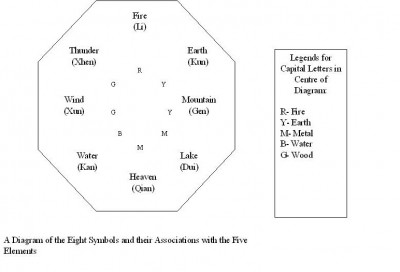
Embodiments of Yin Yang:
Yang and Yi each have four embodiments that characterise the possible nature of the spells that correspond to these two base concepts:
Yang- ri (day), ren (realm of the living), dong (movement), ti (body)
Yin- ye (night), ming (realm of the dead), jing (stillness), wun (soul)
Wu Xing in relation to each other:
The doctrine of Wu Xing describes two cycles- a creation cycle and a destruction cycle, of interactions between the five elements in the following way:
Creation cycle:
- Wood feeds Fire
- Fire creates Earth (ash)
- Earth bears Metal
- Metal enriches Water (as in water with minerals is more beneficial to the body than pure water)
- Water nourishes Wood
Destruction cycle:
- Wood parts Earth (such as roots; or, Trees can prevent soil erosion)
- Earth dams (or muddies or absorbs) Water
- Water extinguishes Fire
- Fire melts Metal
- Metal chops Wood
Source: http://en.wikipedia.org/wiki/Wu_Xing
Wu Xing and Distinguishing Spell Characteristics
Metal- balanced characteristics in terms of casting speed and effects
Wood- almost instantaneous effects from spells
Water- spells with long-lasting effects
Fire- spells that deal heavy damage
Earth- effects of spells appear slowly but cover a wide area
Ba Gua and Corresponding Map Bearings and Formations
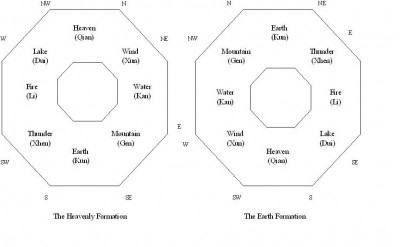
Ba Gua is the Shou term for the octagonal instrument that magic practitioners of the Eight Symbols use to detect the presence of ‘energies' corresponding to the Eight Symbols as well as the Eight Symbols themselves. (To prevent confusion, from this point onwards, only the instrument will be referred to Ba Gua). This instrument also serves to remind them of the corresponding formations for the Eight Symbols.
There are in general two possible formations for the Eight Symbols to be assembled in, respectively known as the Heavenly and Earth formations (aka the Yang/Yin or Dawn/Dusk formations). The Heavenly formation has the top right hand corner of the Ba Gua designated as North and the rest of the map bearings are allocated in a clockwise function. In contrast, in the Earth formation, the top left hand corner is the Northern direction and all other map bearings are assigned anti-clockwise from North.
Spell Types, Characteristics and Signature Spells (SS) under The Eight Symbols:
Heaven
This is the domain where mortals have no control over encompassing elements such as time, space, life, death and the general weather. Magic practioners under this system adjust their spells to work around elements of the Heaven domain.
Earth
Yang
Ren- spells providing spontaneous healing to the body, based on that which springs from the earth and their life forces
SS- The Healing Hand: a healing spell that will instantaneously remedy small injuries (cuts and bruises) and partially heal a more substantial injury (temporarily stem internal bleeding)
Dong- offensive and evasion spells based on terrains
SS- 1) The Quicksand Trap: conjures a quicksand at a designated spot; 2) Moving Earth- conjures a path of earth that can move (more or less randomly for those with weak mind discipline but becoming more controlled in fashion if the caster has strong mind discipline)
Yin
Ming- enchantments for increasing strength/stamina/endurance/resilience
SS- The Mallet: a spell cast on oneself that subjects the body to a source of stress (physical tiredness, small amount of poison, pain etc.) for a short period of time
Jing- magical seals and spells for detecting whether items have been tempered with or disturbed
SS- The Seal: a spell that puts in place a magical seal tuned to individuals through blood (a drop of the individual's blood is needed to open the seal) or specific items (the key item needs to be in touch with the seal to open it)
Water
Yang
Ren- spells that provide gradual but sustained healing effects
SS- The Healing Spring: a healing spell that will steadily but slowly heal wounds. Its effects last for a given number of time that varies with the caster's power up to a maximum of one hour
Ti- offensive spells based on the element of water and diffusion spells
SS- 1) The Water Arrow: conjures a fast-travelling jet of water to hit a particular target; 2) The Water Curtain: conjures a screen of water that will diffuse attacks with multiple points of contact i.e. anything besides a needle or similar projectiles
Yin
Ming- poison and corruption spells, mimicking the properties of water from the nether realm
SS- Song of the Water of the Forgotten: conjures a puddle of water that is slightly toxic and with a somewhat pungent scent that if inhaled, clouds the mind
Hun- preservation spells, spells providing immunity from psychological attacks (illusions, suggestion spells)
SS- Hymn of the Clear Spring: a spell that can be cast on oneself or others to calm the mind, effective for increasing concentration and repelling psychological attacks
Fire
Yang
Ri- flames that are furious and quick to expire
Ren- a red flame, the flame of the living
SS- Flame of the Cauldron: a flame of a dull pinkish colour that can burn off a variety of poisons and materials harmful to the body from wounds and items
Yin
Ye- clinging, burns for a long time
Ming- a blue flame from the nether realm, highly corrosive
SS- The Nether Flame: a flame of a florescent but cold-toned blue colour that is deadly for its acid-like properties. It will reduce a human sized target to a puddle within seconds.
Wind
Yang
Dong- speed enhancement spells, tracking/tracing spells
SS- Song of the Chase: a spell allowing speedy travel to a mark or an item pre-tuned for this particular spell
Yin
Jing- spells that create cyclones
SS- Song of the Gale: conjures a cyclone at a designated spot
Thurder
Yang Ti- spells with paralysing effects
SS- The Cage of (insert appropriate deity associated with thunder): conjures a circlet of thunder that holds a target in captivity and paralysis
Yin
Hun- spells that sear the mind/soul
SS- The Righteous Thunder Strike (aka The Thunder of the Ninth Heaven): conjures a bolt of lightning that has especially potent effects on the undead and has a light stunning effect on other life forms
Mountain
Yang
Dong- offensive spells based on the power of rockslides
SS- Formation of the Folding Screen of Rock: a spell that can trap multiple targets within an illusory environment with loose boulders that can directed by the caster to hit those trapped
Yin
Jing- defensive spells (shields/barriers)
SS- Hymn of the Mountain: a spell that will not only provide a boost to defence but also keeps the target immobile
Lake
Yang
Dong- spells that are based on the principle of ripples
SS- The Field of Ripples: a spell that conjures a 'force field' that has an all-round augmentation effect on attack, defense and damage share between multiple targets. Its augmentation effect can also be focused on a specific area at the caster's will
Yin Jing- spells that are based on the phenomenon of reflection
SS- Hymn of the Mirror: a defensive spell that reflects any damage back to its source
Practical Implementation:
Practitioners need to be able to draw on the Eight Symbols in some ways in order to cast magic under this system. Each practitioner will have natural empathy to one or more of the Eight Symbols. There are a number of possible ways for drawing on the Eight Symbols:
- Be in proximity of natural phenomena that fall under particular Symbols eg. be close to water sources if needing to cast magic under the Water Symbol and sources of fire for Fire magic
- Stand in the corresponding map bearing for a specific Symbol
- Draw on reservoir items that contain a large reserve of stored 'energies' corresponding to a particular Symbol eg. a pebble that had been at the bottom of a lake for decades. Depending on the potency of 'energies' stored in such items, even practitioners without natural empathy might be able to cast spells based on a particular Symbol with the help of such an item
- Set up a formation (in the spirit of the Heavenly/Earth formation) that enhances the plenitude and potency of particular Symbols within the vicinity
In the actual casting, practitioners draw on the Eight Symbols and then channel and direct their powers towards the spell via their minds. In particular, this channelling and directing process is a very individualistic one in the sense that one caster might picture it as a process of manipulating the Symbols via strings (and this will become his unique way of channelling and directing the power of the Symbols) while another might immerse himself/herself into a particular Symbol and coerce particles under the same Symbol towards certain behaviours.
Spells cast under this system are mostly static or have limiting impact in terms of geographic coverage. In fact, there are a large proportion of spells that operate on the basis of triggers. That is, these spells are tuned to specific locations and intruders or other stimulus are set as the conditions for the spells being activated.
Credits: While this system arises because I am picturing geomancers (individuals who practice Fengshui) as a split off from the Tuner Mages, the impetus for writing this submission really comes after reading an online novel (written in Chinese) which outlines a magic system based on the Five Elements and the Yin/Yang principles. The system I'm outlining here is obviously built upon this basic idea and in addition, the day/night distinction as well as the colour of the flames in relation to the Fire Element are largely borrowed from this novel as well. However, the rest is original work.
Combination Spells
These are spells derived from combining at least two of the Eight Symbols and are commonly known as Formations. They are all trigger spells in nature. All combination spells need to be balanced with respect to Yin-Yang. That is, both Yin and Yang aspects have to be present in a combination spell but it can be skewed towards either the Yang or the Yin. Depending on the spell's purpose, Symbols are arranged* according to either the Creation/Destruction Cycle of Wu Xing or the Heavenly/Earth formations. The strongest combination spells are ones that combine all Eight Symbols, followed by ones that combine Five Symbols that belong to each of the Wu Xing elements.For all other combinations, it does not necessarily follow that spells utilising more of the Eight Symbols would be more powerful. Complexity of the combination spell is directly in proportion to the number of Symbols used to weave it but this does not hold for its power.
Some samples of Combination Spells:
1) The Formation of Ba Gua: This is a combination spell built on the basis of all of the Eight Symbols, with each of Symbols being arranged in accordance with either the Heavenly or Earth formation depending on its purpose. The Heaven Symbol is represented by a common pebble containing no traces of the Symbols if the formation is entirely powered by reservoir items. In addition, the casting of this particular spell is tied to specific times of the year. Depending on the purpose of the spell, these times change. This formation is a all-rounded spell and can be utilised for a variety of purposes such as to entrap but not harm,
for attack/defence as well as others (up to GM discretion).
2) The Formation of Wu Xing: This is built from five Symbols that correspond to each of the Five Elements (Wu Xing). Another all-rounded spell that makes up for its relative weakness when compared with the Formation of Bagua by not having the limitation of being tied to particular times of the year. In addition, this particular formation has the advantage of being self-perpetuating to an extent if arranged according to the Creation Cycle.
3) The Formation of Three Stars: An offensive spell maintained by three mages drawing on a distinct Symbol or if powered entirely by reservoir items, is composed of three sub-formations based on a single Symbol.
4)The Formation of Six Harmonies: Drawing on the six Symbols besides Heaven and Earth, this spell is a powerful cleanser of all negative effects in an area, including plague and evil influences.
This System in the Dragon Empire setting
Under Revamp! Ignore for now!
This is a system of magic evolved from Tuner Wizardry. Practitioners (known as Geomancers) work solely with enchanted items containing elements of the Eight Symbols. In terms of combination spells, Geomancers set them up to be in accordance with the Bagua (an octagonal instrument used by these Geomancers), which designates a range of alternative formations that each of the Eight Symbols need to be arranged in to achieve a particular purpose.
Not Registered Yet? No problem.
Do you want Strolenati super powers? Registering. That's how you get super powers! These are just a couple powers you receive with more to come as you participate.
- Upvote and give XP to encourage useful comments.
- Work on submissions in private or flag them for assistance.
- Earn XP and gain levels that give you more site abilities (super powers).
- You should register. All your friends are doing it!
? Responses (24)
Update: User-created ideas additions done and now ready for voting!
Its a great idea and a great start for a system, but for me I need to see some concrete examples. The whole concept of the layout of rooms and architechure seems to me absent.
Val, are we on the same wavelength here? how come I have no idea what you meant by 'the concept of the layout of rooms and architecture'? The only connotation I get from these wordings is in relation to buildings and if you are referring to the way I built up the concept for this particular type of magic, then I need more clarifications on what you have in mind.
As for examples, I see what you mean. I'll fix up the Eight Symbol section and add some actual spells (spell name+what it does) and fix up the current jumbled-up content on spell types interspersed with spell characteristics. Thanks for the suggestion.
My perception on feng shui was it was the art of placement of objects within rooms, or gardens with the intent to improve good energy and prevent bad luck.
Ah I see, you were referring to how Feng Shui works in real life. When I wrote this sub, I guess I was focusing more on the theory side of things rather than the practicals of how it works (through the placement of objects that you mentioned). I think I will add an extra section on the practicals, thanks for pointing it out.
Update: Will be updating this sub slowly (equivalent to 1/2 of a Symbol per day) since there's just so much to be done.
Quite interesting!! Just need to wrap my mind around all the concepts presented before commenting further...
I'm not really sure where to start with this piece. I love magic systems -- especially those with some grounding in real-world mythology, and this is a new one for me. I'm glad that you included the background section at the top.
I think that the ideas you are trying to get across aren't really coming across on paper. If you could make a small diagram or something to help illustrate the various elements & possible combinations it might help. Like val, I want to hear more of the practicalities involved in making this work. Am I just hitting enchanted 'elemental' wands together to cast a spell, or am I grabbing handfuls of dirt and mixing it with water, etc?
I really like this -- the concept is fascinating. Just need a little more clarity before I feel comfortable voting on it.
Fair enough, this has become a in-work sub now as I've indicated and I'm just too slack to take it off to In Work given that there's no traffic on it (until now, that is).
I'm expanding the Eight Symbols section at the moment but periodically I get stuck so maybe I will start on the practical implementation section and just do bits and pieces.
For images, actually that's a good idea, I think it will be particularly useful when I talk abt the combo spells.
Awesome. I really like the flavor of this piece, and am excited to see what you do with it.
Was just coming back to edit my response but you got here before me so I just have to put in another reply. Just wanted to say I'm working on this quite slowly so will PM everyone interested/involved (Mourn has indicated interest and Strolen has to read this given that it's for Strolenati Guild) once all the planned updates are done.
I like how you used Feng Shui to power magic. What I think would improve the system, however, is to have the actual placement-of-objects-in-a-room aspect of Fenshui present. Maybe in a Feng Shui room, the Mage gets some bonuses, or can mentally mess with people who enter. And powerful Feng Shui mages can make an enteree feel so blissful that they never want to, or can, leave... Or drive the person insane...
Anyways, the whole thing is very complete and well-thought out. Good explanations of Feng Shui, though I'd slightly like more credible sources than Wikipedia (yes, I know I'm being hypocritical here).
Okay, I incorporated a very brief description of the architectural/placement of object aspect in the practical implementation section but in general, it's sort of gotten to the pt that this sub will be driving me insane any minute soon.
As for more credible sources, well, this is an exercise in creative adaption, not a research exercise :P Also, from my perspective as a Chinese (and a folklore type of perspective as opposed to the actual grand concept derived from Taoism), I think Wiki is doing okay on this topic
Update: Tying this off for now else this sub is threatening to make me insane. How this system works in the Dragon Empire setting will be revealed one day after I've cooled down a bit with this sub.
Why not upload the image here? Clicking it takes me to a broken site.
When I select my file to upload thru the insert image button, I will see a msg on the left at the btm of my screen that says 'waiting for strolen.com to respond' and then the screen will just go into inactivity.....
Esoterica meets application. Its a much better and thought-provoking piece after all the updates. Some great stuff to steal here for a GM, even if the system isn't used as is.
I didn't see it preupdate but I can definitely see how you actively responded to the comments. This is a nicely formatted and pretty thorough sub. Some of the signature spells are pretty hardcore, but I guess that is why they are SS!
I really like the naming convention you followed for the signature spells, and the elaboration on the combination spells. I would really like to see the larger images -- hopefully you can work that out with one of the site administers soon. I'm still having a little trouble grasping the practicalities of using this system in a game, but perhaps I just need more time to mull over the ideas as presented.
First I love that you referenced your source material, would that more people followed your lead in that department when they post non-fiction works on things involving history or physics. Second this is great idea and it is well executed and it adds a depth to magic that is often sorely lacking. In canonical D&D (last time I checked...which was a long while ago) when one casts magic missile there was no explanation of the forces at work that allowed a universe to function that way.
There is an interesting Yin-Yang to this piece though. It is perfect and exciting as it is, but part of what makes it so interesting is that it demands more explanation and work. It could use a human narrative element and more discussion of how these concepts are used hands on. For example could you explain to me step by step how you envision somebody casting a Ren spell? What I like about this is that it takes something that is often treated fairly abstractly in gaming, casting, and grounds it in a metaphysical technology. But the information you present is still a lot of lists. I think placing this all into a single structured write up-either as write up for GM and players or an in world write up would aide in organizing your thoughts.
Overall-i love it-5/5.
Thanks for the HOH and the score of 5, Axle. Your comment is comprehensive and insightful as always. I can see the value of your suggestion with respect to using a more personal voice on instructing these concepts- it will certainly help to spice up the sub. However, as I've indicated before, I'm currently out of love with this particular sub so for the time being, no more work on it is forthcoming (eventually, there will be some cos I still haven't detailed how this system works in my particular setting- the Dragon Empire. I turned this sub from setting-specific to a somewhat open-to-all system halfway through writing b/c of the Appeasing BH Challenge so yeah, currently this piece is not grounded in any world specifically but can be up-for-grabs in any world)

4.5/5
A very interesting read, given some more time to fully understand it I can see myself implementing it in a future campaign.
Thanks for giving us this Moonlake :)
Moonlake, do you have a name for this system? What is a practitioner called?
Also, I'd really like to know a little bit more about the Ba Gua. It sounds like it has the potential to be a very powerful ritual/summoning/confining spell. What times of the year can it be formed, and will it have a different application in each different time period (Spring vs Winter, etc)? Is it all formed within the caster's mind or are props needed for something this powerful?
I call it the Way of Fengshui for my setting. A practitioner is called a Geomancer (I didn't make up this term, I think that's what Wiki calls them)
I haven't worked out the nuts and bolts for each Symbol wrt this aspect but if you have an ultimate spell based on an element that's around all times of the year, then I think the pt you raised on different application depending on season would apply.