Totems and Tokens
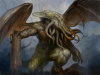
A totem is an animal, plant, or natural object serving among certain tribal or traditional peoples as the emblem of a clan or family and sometimes revered as its founder, ancestor, or guardian. The most well known totems are likely the totem poles of the American indians, and the spirits of the animals and nature also associated with the indians. In a fantasy setting with living gods, spirits, and sorcery, there is no reason that a totem cannot be more than a token or symbol, a chunk of ornamented wood or stone.
The barbarian kiths, with their shamanistic traditions would have the same basic totems as the Native Americans. They would venerate the spirits of animals, their elders, and potent little gods such as elementals. The civilized and settled folk are a little left out. Most fantasy has a large over-arching psuedo-catholic faith. This faith can be monotheistic, pantheistic, or some other power structure but the basics are the basics. You shall have no god/gods before us, and the clerics are the conduits of divine blessings and retribution.
Resistance is Futile
The conquest of a pristine area by the theocratic church displaces local faiths and structures of worship with their own. This is generally a bad thing for the local little gods and spirits who have enjoyed the devotion of the local folk. The spirits that rebel are put down by the likely more potent clergy and their arms militant. The remaining options are generally reduced to surviving on ambient essence and keeping a low profile, or accepting a position within the theocratic cosmology. The first option makes a little god into a beggar, the second sees their individuality stripped away and their core essence reshaped to something more fitting to the will of the greater divinity.
The Path of the Totemos is a tricky one, requireing a little god to maneuver into society without offending the theocrats. The little god must then find a way to receive devotion, offerings and worship from the common folk again without tipping off the clerics or the agents of the divine.
The Modern and Fantasy Totemos
Totemos exist all around us today. We don’t easily recognize them, but we offer our time, devotion, energy, and sometimes money to them. The mascots of professional sports teams are Totemos, as are the anthropomorphic icons and mascots of companies and corporations. In the fantasy setting, these mascots are not guys dressed in large felt costumes, they are real. They can represent guilds, cities, ethinic and cultural groups, neighborhoods and the like. The larger the base that recognizes the totemos, the stronger it is.
A Totemos is not a god in the divine sense, it is a terrestrial spirit. As such, it’s powers are quite limited. A Totemos cannot effect miracles, empower clerics, or make significant changes in the local enviroment, magical or mundane. A Totemos can inspire, offer blessings of good luck, and a small number of other things directly related to it’s core nature. Examples will be provided in the Sample totemos section.
Totemos and Clerics
As a rule, clerics dislike totemos like preachers dislike sunday sports. A totemos distracts the populace from ‘proper’ worship, and divests them of some resources that might be better gifted to the theocracy. This animosity remains calm, as a cleric who campaigns against a totemos is very likely to alienate the populace and come across as an intolerant zealot.
Sample Totemos
Sir Xorice of the Bloody Blade
A militant Totemos attached to the Shroud Knights, Sir Xorice is a war like totemos. Originally a strong ghost of a warrior king, Xorice adopted the Knights of the Shroud after his own funeral worship was crushed by the church. Now filled with ire against the Faith, Xorice lends his blessings to the rebel knights. His main place of devotion is a warrior chapel hidden in the Grandmaster of the Knight’s castle. He appears there in stone effigy as a king with a broken sword, and a broken crown. His devoted wear a broken crown in their heraldic devices and offer their first kill of each battle to Xorice.
The Ghillie-Goat Man
Appearing as man with the head of a horned ram and covered with long shaggy green hair, the Ghillia-Goat man has long been a patron of the small forest village. He was originally worshiped as a god of wood and stone, but has since adopted a more humanoid appearahce. After his druids were slain, he is now a mascot for the local Baron’s knights. Their devices typically have a green goat’s head, or a fist clutching a sheaf of elderberry vine.
The Black Kaawk
The mascot of the Moxingor Slaver’s guild, the Black Kaawk is a large rooster with jet black plumage and a gold beak. Kaawk is hard to take unawares and is has a canny eye for what is a good morsel to eat and what is offal. The guild marks it’s slaves with a tattoo of a black feather on their right hand, and on their right shoulder. Guildsmen will generally display their association with the guild and the Kaawk by wearing a piece of jewelry with a black feather, either real, or a lacquered piece of pewter.
The Shoeless Mouse
The orphanage at Peirs-del-Reyien has a large number of children, many of whom fall to decided rogue activities. The children, and the lay-monks who help in their illegal activities remind each other to be as quiet as a shoeless mouse, and make less of a trail to follow. While the saying is now cliche, the Shoeless mouse is now a Totemos of the orphans and their juvenile organization. Most of the orhpans, no matter how hungry, will leave a crumb of food for the old shoeless mouse to find.
Application of Totemos
Using the above examples, Totemos are easy to integrate into a game. A casual common might not have a clue to who Sir Xorice is, but he knows the knights with the broken crown symbol are bad news. He also is pretty sure that the tavern with the bent crown is pretty friendly to them, even if no one can figure out what is going on. In the case of the Ghillie-Goat man, when the locals decide to play at games (I imagine rugby for some reason) one side will always want to play as the green tunics, or the Goats. The baron might even sponsor a team to play for his entertainment, scheduling matches with the teams of other barons in the region. Slavers are by rule, not pleasant or highly moral people. In a setting with the Moxingor Slaver’s guild, a black feather could carry the same connotations as the Nazi swastika or the Klan’s burning cross. Buying a black chicken could cost several times the price of a brown or white chicken, or the like. The Shoeless Mouse would be an enigmatic figure, his image appearing in odd places, possibly even comic in appearance.
For Totemos more strongly associated with an area rather than a society or organization, the use is a bit more ubiquitous. Like the City-Gods of Mesopotamia, the city and the Totemos are almost interchangable. The Totemos of a city or town will reflect the nature of the area, and of the people. A mining town with a cautious nature might have a Canary Totemos, while a military outpost on a contested border would have a fightin’ totemos, a warrior. The area based Totemos is a central figure for local color, and iconography. Taverns will have it’s image or name, or some association, local knights could have something of it in their devices.
My Inspiration
Collegate and professional sports have very iconic mascots. There are strong associations between a team, their mascot, and their home town. For Tennessee, it is the Volunteers and their mascot Smokey, and at certain times of the year, a large percentage of the local population will ‘Bleed Orange’, one of Tennessee’s color. (the other being white). This sort of local pride should have some counterpart in fantasy. While professional league sports are unlikely, there is nothing saying that a symbol of the guild couldnt become a mascot, and then a Totemos. The reverse might be true, and a guild might adopt the local totemos and use it’s image as it’s symbol. Colorful organizations could certainly have totemos, such as mercenary bands, local based guilds (as opposed to multi-city super-guilds) and fraternities, sororities, brotherhoods, and compacts.
Please
register
to add an idea. It only takes a moment.
Codex
Kugamu
By: Maggot
( NPCs ) Minor -
Mystical ‘‘You want to know why we have that big old granite statute of a catfish? Why son, that’s old Kugamu. Everytime folks around here be wanting to get a good catch from the lake, we grab some maggots, pig shit and old beef gone bad. Then we mash it up all together and toss it into the lake for him to eat. He’s partial to that, is old Kugamu. Bless his heart, he’s never let us down even once’‘.
[
Show / Hide Submission ] [
Visit Submission ]
History/ Background
Asor is a small fishing village located along the banks of a massive lake that lies within the southernmost province of the empire of Neath. For generations, this large body of water has provided the inhabitants with a steady supply of eels, perch, trout and numerous other species of freshwater fish. So varied are the different kinds of fish to be found within the lake that the people of Asor have profited greatly from a bourgeoning trade with neighbouring towns that appreciate the diversity of fish that the little village has to offer.
Indeed, many regional chefs and gourmet diners have commented that fish from Asor, have no parallel elsewhere when it comes to the sheer range of them that are available for sale. Even certain species like the grey pike which notoriously hard to catch, can be easily obtained from the village. As such Asor enjoys some renown and prosperity due to its exports of fish to more cosmopolitan neighbouring towns.
Kugamu
Like most small villages, Asor has its own peculiar local legend that serves to distinguish it in some way from the numerous other villages to be found in the sprawling countryside of Neaths numerous provinces. The story of old Kigamu is such a legend. Told to every male child in the village once he is old enough to accompany to venture into the lake for the first time with his father, it reaches back into the misty past of Asor.
Ages ago, in a past that has long since retreated into obscurity, the village of Asor was a small settlement known as Hagati. Ruled by the people of the Vili tribe, its inhabitants lived under the dominion of their priest kings. These lords were proud and ferocious characters, quick to lead their warriors in raids against neighbouring tribes that dared question their honour. And none of their subjects would gainsay them whenever such an expedition was launched, for the priest kings were believed to be the incarnations of the revered deity known as Kigamu.
Master of the fish that swam in the lake, he alone could command the denizens of that watery expanse to allow the nets of the fishermen to ensnare them and thus feed his people. Reflecting this fact. the name ‘‘Kigamu’’ itself meant ‘‘Master of the fish’’ in the Villi language. To commemorate the vital role he played in feeding the Villi, every year, during a day widely regarded as the beginning of the season during which the fish would spawn, a powerful ceremony was enacted to ensure the continued wellbeing of the tribe.
The priest king, who was no less than the mortal vessel of Kugamu, would venture onto the surface of the lake on a raft. Chanting the scared hymns that praised his own divinity, he would then hurl pots of baked clay containing savoury dishes into the lake for the fish to feast upon. This ceremony symbolised his powerful connection to the fish dwelling in the lake as Kugamu.
This link was powerfully expressed by the royal insignia that adorned his clothes, a highly stylised symbol of a catfish. Able to thrive in the murkiest and most mud choked parts of the lake where other fish would quickly perish, these hardy fish symbolised the resilience and fortitude that the king himself was believed to posses as the embodiment of a deity that enabled his devotees to thrive even when other neighbouring tribes might starving to death after terrible crop failures. Indeed, they were regarded as the king’s personal possessions and no commoner could catch and eat them, on pain of death.
Neathia
But as the ages passed, a pattern that had sustained the social and political fabric of Villi society for centuries would rapidly unravel. Increasingly, the priest kings of Villi became too absorbed in the ceremonial aspects of their rule and begun to neglect their more earthly duties as kings, influenced as they were by ambitious chiefs who persuaded their royal masters that as the shells of Kugamu, their true duty was to honour their own divinity rather than attend to the more mundane tasks that could be attended to by their vassals.
Meanwhile, the emerging kingdom of Neath in the far north was becoming a powerful force to be reckoned with. As the Villi kings retreated further within the confines of ceremonial pomp, the armies of Neath were becoming ever more powerful. At last when the entire north had been subjugated by the tenth king of Neath, that ambitious ruler ordered his armies to subdue the pagan south in the name of Neaths supreme deity, Neathia, omnipotent lord of the universe. Everyone that tried to resist was crushed the advance of this immense hoard was swiftly crushed. Hundreds of kings and princes were crucified by the victors as an example to others that would seek to oppose the authority of Neath.
Finally, when all their neighbours had been subjugated one by one, the Villi found themselves facing an invasion by a massive army led by ruthless and fanatical generals.
Terrified by the prospect of mass slaughter, the craven advisors of the Villi king betrayed their own lord and delivered him into the hands of the enemy. Following this shameful act of treachery, they offered their submission to the throne of Neath.
What followed next was the end of an era that had endured for as long as the Villi could remember. The most powerful man among the traitors who had surrendered the kingdom to the enemy, was summarily named mayor of their ceremonial capital located along the great lake while the domain traditionally held by the Villi royal line passed to the crown of Neath.
What was the most painful act of subjugation for these once proud people however, was the gruesome execution of their imprisoned king by his ruthless captors. On the orders of the leading Neathian general, the king was chopped slowly into bloody shreds even as he continued to scream in vain for the mercy that was never displayed. Once this grisly act had been accomplished, his remains were tossed into the lake for the fish to devour, in a savage mockery of the sacred ceremony that the slain monarch’s predecessors has traditionally enacted in better times.
A similar fate was subsequently inflicted on all his living relatives, thus bringing an end to the royal line that had ruled the Villi for centuries. The gruesome message conveyed by this act of regicide was clear. The age of kings had finally come to a close. From henceforth, they would be the subjects of the emperor of Neath. Grief stricken, some of the erstwhile subjects of the slain king privately prayed to Kugamu to forgive them for their failure to protect his final mortal shell from an untimely death and begged the god to remain forever in the lake as a protective presence that would always be around whenever his people needed his assistance.
To reinforce the destruction of Villi independence, all symbols of the king’s worship were delibratley destroyed by the invaders. Moroever, missionaries charged with spreading the faith of the intolerant supreme deity Neathia, were despatched in huge numbers to harass and intimidate the Villi peasantry into abandoning their allegiance to Kigamu and accepting the alleged truth that Neathia alone was the only god in existence truly worthy of worship. All other entities that had been hitherto revered as gods were merely evil spirits sent to lead mortals astray from the path of virtue and righteousness.
In a final act of asserting the newly attained supremacy of Neath, the conquerors even went so far as to rename the lakeside settlement of Hagati as ‘‘Asor’’ which simply meant ‘‘place of the big lake’‘.
As the following centuries developed, old shrines dedicated to the former royal lineage were torn down and churches dedicated to the worship of Neathia were erected in tear place. Eventually, the descendents of the Villi wholeheartedly embraced this alien god as their saviour and Kugamu, the god revered by their ancestors, soon became a pale shadow of what he once was.
As a consequence of the mass conversion of the Villi to the Neathian faith, the story of Kugamu underwent a radical transformation in the ensuing ceremonies to the extent where the current legend bears only a slight resemblance to the original myths. The village storytellers now regal the young sons of Asors fishermen with dramatic accounts of the demon Kugamu who still dwells in the great lake.
In ages past, so the story goes, Kugamu was a diabolical lake dwelling demon that had always demanded that the people of Asor feed it their firstborn sons on a yearly basis.
Cowardly and weak as they were, the townsfolk lacked the courage to stand up to the abominable monstrosity that lurked in the murky depths of the lake and were thus forced to hurl weeping, helpless infants to their doom in the dark waters. But now, so the elders say, the people of Asor no longer need to fear the monster. Two centuries ago, a magnificent army arrived from Neath to liberate lands that were still under the oppressive sway of heathen beliefs that were an insult to the true god Neathia. As these holy paladins marched into lands bordering the great lake of Asor, they were immediately accosted and questioned by curious onlookers as to their purpose in arriving in this sleepy little fishing village.
The courageous warriors of Neath replied instantly that they had come to serve the will of their god by ridding the benighted pagan lands of the evil that plagued them. At this brave and steadfast answer, the people of Asor instantly went down on their knees and piteously begged the soldiers of Neath to save them from the foul abomination that dwelled in the lake, emerging from it only to demand the flesh of their precious children to gorge itself upon.
Touched by their appeal, a priest who had accompanied the army, swore that with the divine blessing of Neathia, the omnipotent and uncontested creator and lord of the entire universe, he would put an end to the tyranny of this vile fiend forever. Once he had made this declaration, he strode to the bank of the great lake and challenged the demon that called itself Kugamu to emerge from its lair and face him in battle. Immediately, enraged by the insolent challenge offered to him by a mere mortal, the vile monstrosity emerged from the surface and charged at the priest.
As the storytellers tell it, the demon resembled a hideous amalgamation of catfish and human features combined together in a blood curdling patchwork of utter terror. Possessing the limbs of a human, but resembling a hideous catfish in all other respects, the abomination moved swiftly to enclose the brave cleric with its jaws and devour him in one fell gulp of its mouth.
But even as its slimy jaws closed around the head and torso of the priest, seemingly tolling his death knell, the ebon scales of the monsters grotesque and misshapen mass begun to visibly shift and distort, seemingly melting. Horrified by the inexpiable transformation befalling it and wracked by agony, Kugamu abruptly released its death grip on the priest and unleashed a wail of agony as it rapidly retreated away from the man that had caused it such pain.
As it begun to cower in abject terror, utterly helpless to halt the waves of pain coursing unrelentingly through its body, the priest begun to stirringly invoke the power of divine Neathia, the one true god, to rid the world of the infernal horror that had dared to question His might. As the priest’s chanting reached a powerful climax, before the astonished and jubilant eyes of the crowd, something truly miraculous unfolded.
The trembling monster shrunk rapidly in size and soon transformed into a mere catfish that thrashed pitifully as it gasped desperately. With a triumphant smile on his face, the priest cried aloud a paean of praise to Neathia, the Lord of All creation and then grabbed the wriggling fish with his hands. Calmly, he tossed it into the lake.
From henceforth, he declared, the demon Kugamu would no longer trouble the people of this land with his incessant demands for the flesh of their infants to feast on. Instead, trapped eternally in his much humbler form as a common catfish, he would feed on whatever offal that they found it in their hearts to offer him. And in return for their generous offerings, he would ensure that the people of Asor would always have fish to eat. Should Kugamu ever fail in this duty whoever, he would be snatched from the lake and eaten. And thus was born the current legend of the monster dwelling in the lake bottom. Moving songs are still sung in the village’s tavern about the brave but sadly anonymous cleric who did battle with the demon Kugamu and successfully conquered him.
Rehabilitation
It is obvious that centuries of intense indoctrination by intolerant clerics of the faith of Neathia have radically distorted and twisted the truth surrounding the being that was once worshipped by the Villi as a god.
Once hailed as a powerful deity that periodically manifested as a mortal king to rule over the Villi, he is now nothing like the divinity that he was formerly revered as. In a throwback to the ceremonies once carried out by the extinguished royal line of the Villi, the village fishermen now hurl a fermented mash of pig dung, maggots and rotting beef into the lake for Kugamu to feast on. This is done prior to every fishing trip in order for them to get a good catch since Kugamu is regarded as the lord of the fish that dwell in the lake and hence can command his scaled subjects to cast themselves into the nets of the fishermen of Asor.
The local clergy for their part, have no objection to what they perceive as a quaint but interesting little custom. This indifference stems from the fact that the people of Asor firmly acknowledge that Kugamu is hardly a god in his own right, but is rather a humbled and humiliated former demon who continues to rule over the lake in his much reduced state only at the express will of Neathia, the supreme deity that rules over all. Indeed, the people of Asor feel pity more than anything else for this alleged fallen demon.
In recent years however, Kugamu has enjoyed a new lease of life as the village’s mascot. Two years ago, the mayor ordered that a large granite statue of a catfish be placed in the tiny village square to commemorate the momentous transformation of Asor’s old oppressor into a friendly ally.
To this day, fifty years after its initial construction, little boys about to venture onto the lake with their fathers for the very first time, often stop to gawk at the statue in awe. When they question their fathers about the its strange province, they are dutifully told about the legend of old Kugamu, the immortal catfish that lives in the lake. Moreover, small wooden carvings of catfish now decorate the interior of the village tavern, while young men who compete against players from other villages in the annual inter-village wrestling matches, always wear jerkins with an image of a gap mouthed catfish sporting a magnificent pair of barbells embroidered on them.
Even the local vicar, despite his silent disproval for such paganish superstition, readily hands out baked sweetmeats in the form of a catfish to the little children during every festival day. Hence, to a visitor who didn’t know better, it would appear that the village of Asor has a serious obsession with catfish.
Perhaps the most interesting manifestation of Asor’s fixation with the legend of Kugamu, is the taboo against the eating of catfish within the village. Although catfish thrive in the lake, the people of Asor refrain from eating them, for fear that any catfish they scoop out of the water might very well be none other than Kugamu himself.
Roleplaying Notes
Kugamu is actually a Totemos or a minor spirit. Though prevented forever from reincarnating in a mortal form by the accursed men of Neath who so viciously slew his last mortal vessel, he continues to watch benevolently over his people. In return for their meagre but heartfelt offerings, he continues to exert his remaining strength to inspire the local fisherman to sail out with the confidence that they will get a good catch.
So powerful are these feelings of confidence he engenders, that the fishermen inevitably find their expectations fulfilled. Additionally, he also bestows small blessings that provide the occasion stroke of good luck when a fisherman succeeds in netting more than his usual catch. As a result, the people of Asor regard him with genuine fondness for what they see as his steadfast agreement in upholding the bargain that was imposed on him so long ago.
Although he is aware that his legend has been distorted in the most vicious way imaginable, he remains loyal to the people of Asor, refusing to forsake them for a crime that was not theirs. Instead, he only blames himself for having listened to the treacherous counsel of false advisors, while he yet ruled as king of the Villi. Moreover, their heartfelt affection for him also prevents him leaving the confines of the lake since if he were to do just that, he would simply be another wondering spirit with no one to provide him with offerings and other gestures of supplication.
Hence, he has resigned himself to living in the lake in the guise of a mere catfish, the form he assumed after the murder of his last mortal shell. It is the only thing that reminds him of what he once was, all that remains of his former glory. Understandably, he is a rather melancholy creature, an extremely pale shadow of the proud deity that he once was.
Add/View Ideas (0)
Add/View Comments or Vote (3)
Mnogos, the historian of spirits
By: Elbin
( NPCs ) Scenario Based -
Knowledge/Lore A traveling scholar, digging up the roots of totemos that he encounters.
[
Show / Hide Submission ] [
Visit Submission ]
Appearance
Mnogos has the looks of a traveling healer - a simple brown robe, graying long hair, a sack full of herbs and remedies on his back. He comes into the village with a slow step, his sandals slapping quietly in the evening dusk. He enters the inn, if one can be found, noting its name and sign, and after getting some food from the innkeeper starts asking questions about it. Then he asks if there are any recently injured people in the village and how to find them, offering his services as a healer. If he can, he finds a friendly household to spend the night.
The next day he seeks out the ill and injured, talks to everyone, even the children, and by the time the last runny nose is accounted for he already knows if there is an interesting story to be found around the place. In the evening he sits down and records all he has learned through the day, preparing himself to call on the local spirits the next day.
History/Background
This scholar (the word "elderly" still doesn’t apply fully for him) has made a life out of the local minor deities and spirits, sometimes referred to as totemos. An orphan, he grew up in a quiet and peaceful monastery, tucked into the feet of a mountain far away. Bit by bit, he has developed an interest in the minor spiritual beings, living in this world. These beings, he reasons, have a closer relationship with the peoples of the earth, and although they are given some thought less often than the gods of the prevalent religions, if thought about at all, they exist in the background of everyday life. The uncovering of these spirits and the recording of their history has given his life a purpose, that he pursues far off the grounds of the monastery, his home.
Once in a while, Mnogos returns to the monastery to deposit his accumulated knowledge in the library, and to take a rest from traveling for a week or two. Then he marks a new destination and sets off on his search. The abbot of the monastery tolerates his interests, because Mnogos travels as a healer, helping the people on his way.
Calling the spirits
The next day after arriving in the village, if there are no more sick people to attend to, Mnogos starts looking for a convenient place to call on the spirits of the place. Many times it’s just the main square, street or crossroads, in their role of the main concentration of life force in the village, when there are no places of worship worth investigating. In that case he spends the day sitting near the spot and listening to the sounds of the gathering of people, trying to hear some shadow of the former spirit that moved through their minds and souls in the past times. Maybe he hears nothing, maybe he really touches another plane of existence, no one can tell for sure. At the end of the day he opens a book and starts writing, often drawing the attention of the kids from the village. He ends up giving away pictures he drew on his travels, spending the precious paper that he has to replenish from time to time in bigger cities or from traveling merchants.
If the totemos has left an imprint in the form of a mascot, an image worn by a group of people in the area or village/town, Mnogos tries to come in contact with then, talk with them about their everyday chores and how they live their life. He would ask a direct question about the image if he is sure there will be no discomfort or worry for the people that use it. His manner is very composed and non-invasive, trying to soak in the spirit of the totemos, instead of extracting it from the people that carry it. He will often offer help to the group under the totemos, to be able to get into their shoes even more. As a result a lot of people that carry the sign of a totemos have heard about him, even if they don’t know or remember his name.
When there are (or were) notable places of worship, however old and hidden they might be, a single rumour is enough for Mnogos to go searching through the nearby forests, plains, mountains and deserts for any remains of these ancient spots. He has an uncanny knack for finding spiritually significant places, which the players can feel if they travel with him. When a place of worship is found, he examines it from every possible direction, touching the remains of the shrines and altars, searching for the energy of the spirit. Again, there is no outer sign of what he feels or sees, or hears, but after such an examination he has a lot to write in his spirit tomes.
Mnogos has a strong connection with the spirit world, so much is already obvious. He really has visions and hears the mirrored sounds of the totemos acting and moving through the people of the earth. He doesn’t see the spirit itself, but senses the way it guided the actions of people, be it with fear, faith or respect. He sees the imprint spirits leave on/in people. This stretches to places and objects by way of the importance people put in them, or the way they acted there and then. He can see the power of a totemos that was worshiped at a shrine a thousand years ago by feeling the imprint of the emotions and actions of people in this places, that were caused (the actions) by the totemos.
Roleplaying Notes
- Interaction and Tutorship
Mnogos is a very friendly character, offering aid to the party even if they don’t have a way to repay him. Of course the best way is to offer him an opportunity to practice his skills. If there is a character that belongs to a group with a totemos, like a knight or possibly a mage, Mnogos will be interested in their group practices and life, and in their totemos, if the character is open to him. He will explain his work and can act as a tutor to some characters that have an inclination towards the spiritual. Such characters does not have to be priests or mages, or psychics. The most ordinary warrior can have an interest in the way spirits move in our world, either as a hobby or a perceived way to further his training and skills. Martial arts, and most arts in general, usually have a spiritual part, and the awareness Mnogos can offer is a great step towards (and possibly beyond) the state of mind of the samurai and ninja of legend.
- The Spirit Tomes
Mnogos writes down his observations on each and every totemos he encounters, and these notes are put on separate sheets of paper, bound in thin wooden slats with leather straps. He usually carries around two or three of these tomes. The interesting thing to mention is that although he mostly sits around, looking and listening to people, when he starts writing the most intricate and detailed descriptions or rituals and traditions and rules are put on paper. One can almost believe that he traveled back in time and witnesses the rites himself, before describing them. This makes his notes very valuable to people interested in the old spirits. More often than not such people are of the evil-dark-spirit-power-wielding persuasion, and Mnogos is aware of that. That’s why he never gives away the level of detail he sees in the places where old totemos dwell. Even if he is tutoring a character, he will not tell them the significance of his full works.
Plot Ideas
- Dealing with a spirit gone rogue - Sometimes things in the spirit world change, for better or worse, and ordinary people can suffer from it. The party is put in the middle of such a change, either by being directly targeted, or just passing by at the moment. In this case they should know about Mnogos beforehand (or meet him on the spot), as a person at home with totemos, even as one that has studied the spirit in question.
- The PCs meet Mnogos and are drawn in his latest search for a lost totemos. A nice way to hook up a journey through the jungles/harsh mountains, looking for the lost shrine of the spirit. Even if it is a simple rock pedestal, with no treasure and no monsters, if the party is one that recognizes the spiritual part of the world, they can get some experience (not only in the XP-points sense) and feel for the world they live in. Treasure and monsters/cults/natives/anything-else are addable at any point of course.
- Mnogos asks the party to travel with him to the monastery. This is possible if he really trusts them as it brings them closer to his work.
- Rescuing Mnogos from imprisonment - an overprotective group of people, possibly a cult, have put him in a cell because they think he is after their secrets. The party receives a plea for help from a friend of Mnogos, or maybe they are currently looking for him? A way to put them in the path of a cult, or vice-versa.
- A task for an evil character or party - to obtain Mnogos’s notes on a certain spirit, or maybe as much as possible of his works, and use them to gain power. How the players know about his notes is left to the GM. How an ancient totemos of unknown strength reacts when summoned on the spot by a ritual that hasn’t been used in a thousand years is also in GM’s hands, but can become the players’ problem.
Add/View Ideas (0)
Add/View Comments or Vote (7)
November 24, 2008, 14:53
November 24, 2008, 15:38
November 25, 2008, 7:49
November 25, 2008, 11:04
November 25, 2008, 11:17
November 25, 2008, 11:43
November 25, 2008, 16:21
Does it ever happen, that a little god becomes a true one?
November 25, 2008, 22:54