Uppsala 1938: Intro + Act I
Pulp-Horror scenario set in Uppsala, Sweden, in 1938. Short setting package followed by the introductory scenario "House of Spirits". Very generic format for easy adaption to any system.
Uppsala — City of Secrets
Sweden and the World in 1938
The years leading up to the outbreak of the Second World War are marked by a dangerous mixture of appeasement, shifting alliances, and wishful diplomacy toward an increasingly emboldened Nazi Germany. With the horrors of the Great War still fresh in memory, the great powers — Britain and France above all — cling desperately to negotiation and political maneuvering in the hope of avoiding another continental catastrophe. The United States retreats into isolationism, while newly formed Soviet Union is consolidating under the iron grip of Josef Stalin.
To the average citizen, the world does not yet feel like it has begun an inevitable slide towards war. But anyone with enough political acumen can smell conflict in the wind. As early as 1936, Germany has reoccupied the Rhineland — a vital industrial region — without meaningful resistance. The Luftwaffe has blooded itself in the Spanish Civil War, treating the conflict as a rehearsal for what is to come. The great powers’ policy of laissez-faire plays directly into Hitler’s hands, giving him time to refine his war machine.
The overture to the next great conflict begins in March 1938, when Germany annexes Austria in the so‑called Anschluss. Only a month after the events of this adventure, the Munich Agreement is signed, forcing Czechoslovakia to cede the Sudetenland to Germany. Emboldened, Hitler raises his demands further, insisting that Poland surrender its western provinces to the expanding Third Reich — a demand that will, in time, ignite the war everyone fears.
Both sides scramble to acquire the occult powers needed to withstand war – and Uppsala is a focal point, a common ground where the forces meet.
A brief history of Uppsala
Long before Uppsala became a university town or the ecclesiastical heart of Sweden, it was a place of gathering, worship, and quiet dread. The earliest settlements clustered around the fertile banks of the Fyris River, but the true center of power lay a few kilometers to the north — Gamla Uppsala, where the great burial mounds rose like sleeping giants from the earth. Here, in a great temple hall dedicated to the old Aesir gods, kings were crowned, sacrifices were offered, and the boundary between the mortal world and whatever lay beneath it felt perilously thin.
With the coming of Christianity in the 11th century, the old site was abandoned in favor of a new city to the south. The cathedral was raised stone by stone, a monument to the new faith built almost defiantly in the shadow of the old. Over the centuries, Uppsala grew into a center of learning and theology, its university attracting scholars, natural philosophers, and later scientists from across Europe. Yet even as rationalism took root, the city never fully escaped the weight of its past. Strange tales persisted — of lights over the mounds, strange figures moving in the river fog, of ancient agreements best left unbroken.
By the early 20th century, Uppsala had become a quiet academic town, its cobbled streets and venerable institutions projecting an air of calm stability. But beneath the surface, the old layers remained: pagan, medieval, scientific, and something older still. In 1938, as Europe edges toward catastrophe, Uppsala stands at a crossroads once more — a place where history, scholarship, and the unseen currents of the Arcana converge in ways few truly understand.
For reasons no scholar agrees on, the Arcana flows more freely here than anywhere else in Scandinavia. Spells that sputter elsewhere take root in Uppsala with unsettling ease, as if the weave of reality is thinner, more compliant, more willing to listen. Even the most cautious practitioners admit that something in the soil, the air, or the very bedrock amplifies their workings. Some claim the city sits atop a natural confluence of unseen forces; others whisper of a wound in the world that never fully healed.
Uppsala’s architecture reflects this layered past. The old town is a tight weave of narrow streets and ancient stone buildings, some dating back to the Middle Ages, their foundations sunk deep into soil that has seen far too much history. These structures lean toward one another like aging scholars in quiet conversation, their courtyards and alleys holding centuries of footsteps. Beyond this older core, the newer districts — “new” in Uppsala meaning the 18th century — are lined with wooden houses painted in soft, weathered colors. They stand lighter and airier, built in a time when the city imagined itself modern, yet still carrying the quiet restraint of Swedish craftsmanship. Together, stone and timber form a city that feels both ancient and lived in, scholarly yet haunted by its own foundations.
Uppsala in 1938 is a city that wears its age with deceptive grace. Beneath the cathedral spires and university halls, beneath the cobblestones worn smooth by centuries of footsteps, something ancient stirs. Scholars speak proudly of Uppsala’s history — the burial mounds of Gamla Uppsala, the venerable university, the cathedral that has watched over the city for nearly a millennium. But there is another history here, one not written in books or taught in lecture halls. A history whispered in back rooms, encoded in runes, and buried in places where the earth remembers too much.
For generations, Uppsala has been a neutral ground, a place where monsters and monster hunters alike may walk without drawing blades. Powerful practitioners of the Arcana, unique supernatural beings, shy nightfolk, autonomous Golem, ancient Undead – and regular human beings - all live under the fragile protection of the Uppsala Accord, an agreement older than any human memory. Hunter organizations and predatory monsters alike respect it. State agencies and organizations like the British Occult Service, the Order of St. Erik, the American Society of the Silver Key, and even the Ahnenerbe’s occult division maintain embassies here, their agents smiling politely across tables they would rather overturn.
This uneasy peace exists for one reason: everyone wants access to Uppsala’s Arcana-rich ground, and no faction can afford to let another claim it alone. The city is an Arcana oasis, a crossroads not by geography, but by necessity — a demilitarized zone built atop something none of them fully understand, a place where the unknowable forces of the Arcana are more abundant than elsewhere– and strangely compliant to human manipulation. This factor alone makes this little Swedish university town Europe´s occult center, a place in which all factions need to maintain a presence. A demilitarized zone, a meeting ground, but also a refuge for those that, elsewhere, would be hunted down and burned.
There are many theories as to why the Arcana is so abundant in this particular area. Some say that long before the first burial mound was raised, before the last Ice Age, something vast and alien fell to the earth here; a cosmic being of impossible scale and unknowable anatomy – a god - whose fall tore a wound in the fabric of reality. The mounds, they say, are not graves but sutures in a barely healed scar; the Accords not diplomatic measures but part of a containment procedure for a fossilized corpse too large and alien for reality to absorb, instead encysted in the weave of reality like a foreign body in flesh. Its fall triggered an Ice Age, and glacialization smoothed over all physical traces of its impact
They say the Arcana that hums beneath the city is merely the leakage from the torn veil between this world and the one beyond, like fluids leaking from a festering wound, unable to fully heal. Whether this is truth, metaphor, or madness depends on who is asked, but the ground trembles often enough to keep the question alive.
Uppsala University stands as warden of the Accords, responsible for holding this delicate balance together. Officially, the university has four faculties, but in reality, there is a fifth. A hidden academic body dealing with forbidden knowledge, known as the Concilium.
The Concilium is a secret branch of the university’s administration, known only to a handful of scholars, politicians, and supernatural dignitaries. Its members deal with the Arcana, the true form of magic — not the symbolic rituals of the occult, but the alien, dangerous operating system that lies beneath. They understand that magic is not meant for human minds, that every spell is a command issued to something vast and indifferent, and that the cost of using it is never fully known until it is too late. The Concilium does not seek to master the Arcana. They seek only to manage it — and to keep others from tearing the city apart by misusing it. They maintain the fragile truce between the opposing groups by equal amounts of diplomacy and political blackmail. Its ruling body sits in judgement of anyone, man or monster, who dares threaten the balance.
But the Accords are weakening in these turbulent times. Strange tremors shake the ground near the burial mounds. Cults whispers that an ancient god is stirring. Younger monsters – vaesen - chafe under the old rules. Foreign agents circle like wolves, sensing opportunity as Europe edges toward war. They squabble, deal and jockey for position, trying to acquire Arcane powers for themselves while keeping it out of the hands of their enemies. And in the shadows of the cathedral crypts, something ancient shifts in its sleep, not itself involved, but irritated by the disturbance.
Uppsala remains calm on the surface — a university town of bicycles, lectures, and quiet cafés. But those who know where to look can see the cracks forming. The air tastes of secrets. The nights feel longer. And beneath the city the Arcana hums like a distant engine, waiting for someone foolish enough to touch it.
In 1938, Uppsala is a city on the brink — a crossroads of folklore and cosmic dread, of diplomacy and deception, of monsters who wish to live in peace and humans who do not understand the forces they are awakening.
And into this delicate balance step the players.
The Uppsala Accords
Long before Uppsala was a city, before the cathedral rose and the university claimed the hill, there was a crossroads. A patch of open ground where the earth felt thin and the air hummed with unseen currents. The people who lived here — hunters, herders, wanderers — knew better than to fight on that soil. They felt watched. Judged. Bound. Their shamans dreamt dreams of power and prophesy by the banks of the river.
From this unease grew the first version of what would become the Uppsala Accords. No one agrees on who forged them. Some say it was the vittra, the hidden folk who shaped the land before humans learned to till it, that wrought the Accords before withdrawing to their subterranean realms, retreating before the expansion of humanity. Others claim the earliest shamans struck a bargain with something beneath the mounds — a presence that demanded order in exchange for silence. A few whisper that the Accords were not made at all, but discovered, carved into the bedrock long before any living creature walked the earth.
Whatever their origin, the Accords endure. They are not written in any book. They are not enforced by any court. Yet every faction in Uppsala — human, monster, and everything in between — obeys them. Not out of respect, but out of fear. Those who break the Accords do not simply face retaliation from other factions. They face consequences that no one fully understands.
The Fifth Faculty believes the Accords are a kind of Arcana protocol, a self‑executing law woven into the fabric of the region. The Nocturnal Court insists they are older than magic itself. The Custodes call them pagan superstition, even as they refuse to violate them. The Sarcist Church has tried — and failed — to unravel them, leaving behind only twisted remains and cautionary tales.
The Accords, as far as they can be understood, are simple in principle:
- No magical conflict within the bounds of Uppsala.
- No forced revelation of the supernatural to the public.
- No tampering with the mounds of Gamla Uppsala.
- No summoning or binding of entities beneath the city.
- No Arcana workings that threaten the balance.
Every group interprets these rules differently. Every group bends them. Every group looks for loopholes. And yet, the Accords hold. When they are strained, the city trembles — lights flicker, animals panic, the river rises without rain. When they are broken, something stirs beneath the stones of Gamla Torget, and the guilty rarely survive long enough to repeat their mistake.
In 1938, the Accords are fraying. War looms. Factions maneuver. Secrets multiply. And the ancient power that forged the Accords is no longer content to sleep.
The Arcana
Magic was never meant for humans.
The Arcana is not a spell system or a tradition. It is the underlying protocol of reality — a cosmic language older than humanity, older than the gods, older than anything that has ever drawn breath. Humans did not invent magic; they merely brushed against it, like animals gnawing on electrical wires.
Most “magic” practiced by mortals never touches the Arcana at all. Tarot, runes, astrology, and ceremonial rites are safety interfaces, filters — symbolic metaphors built to keep human minds from shattering. They let mortals gesture at the real thing without making direct contact, like handling raw Plutonium with sugar tongs.
True Arcana work is something else entirely, the domain of gods and demons. To use the Arcana is to issue a command to forces that do not think, do not care, and do not negotiate. Every spell is a bargain with something vast and indifferent. Every effect incurs a debt, even if the caster doesn’t understand it yet – and the Arcana always collects.
The human mind did not evolve to comprehend the naked mechanics of reality. The deeper one peers into the Arcana, the more the mind bends under the strain. Understanding too much is as dangerous as understanding too little. Madness is not a side effect; it is the natural consequence of perceiving truths the human brain was never designed to hold. Humans are like children pushing buttons – inputting instructions - on a vast, alien machine whose function they lack the neurobiological tools to even comprehend.
Worse still, reality resists change. The universe does not appreciate primates tinkering with the source code of creation. When the Arcana is invoked, the world pushes back — subtly at first, then violently. Lights flicker, animals panic, structures groan, and the air thickens. Unshielded humans suffer migraines, vertigo and nose bleeds. The more drastic the alteration, the harder reality snaps to correct it.
For GMs, the Arcana should feel:
• Inhuman — it does not care what the caster wants.
• Dangerous — even “success” leaves scars.
• Unpredictable — the caster never fully understands what they’ve invoked.
• Transactional — something is always taken in return.
• Resisted — the world itself pushes back against the intrusion.
• Mind‑breaking — knowledge is as dangerous as power.
When characters touch the Arcana directly, describe sensations that don’t map cleanly to human experience: a taste of geometry, a sound with no source, a memory that isn’t theirs. Magic should feel like a glitch in the world. The Fifth Faculty understands this better than anyone. They don’t try to master the Arcana — only to survive it.
ACT I: THE HOUSE OF SPIRITS
Synopsis
Uppsala, July 1938.
Dr. Otto Weir, a notorious historian and occultist, has died in his home under mysterious circumstances. Karl‑Ulrik Vändel, Weir’s former brother‑in‑order and dean of the Department of History, hires the investigators to—under cover of darkness—remove certain sensitive occult texts from the deceased man’s safe. Time is short; it is already Sunday, and the estate inventory officer arrives Monday morning.
The investigators are still blissfully unaware that Weir was a spirit‑summoner of considerable skill, who enslaved and tortured hordes of spirits for occult information and the locations of powerful ancient artifacts. The impressive manor just outside Uppsala is full of restless and furious ghosts. To complicate matters further, the investigators are not the only ones drawn to Weir’s house in the dead of night. On Uppsala’s dark streets, agents of the Nazi occult division—Ahnenerbe—are also on the move, seeking the hidden treasures of knowledge stored in the old wooden villa.
After passing the many magical traps and protective wards Weir placed over his home, the investigators are attacked by various ghosts, poltergeists, revenants, wraiths, and other undead that have slipped free from their captivity in the manor—and who are only all too eager to vent their grievances on the living. The undead Bronze Age shaman Ogrun, resurrected as a powerful gast, leads the spectral horde.
If the investigators emerge victorious and return the restless dead to their slumber, they leave the House of Spirits with newfound knowledge of the hidden world, ready for Act 2: The Black Horn. One of them will return marked by an ancient god, with unknown consequences.
Otto Weir
Weir was an aging academic, in his youth a prominent archaeologist and historian. His fixation on the occult took over in later years, and he has spent the last 25 years ostracized by the archaeological community. Most consider him a crank—a madman who let his fascination with arcane matters ruin a promising academic career. His closest neighbors knew him as a quiet, elderly man in well‑made but worn clothing, at least on the rare occasions he ventured outside.
Weir and Vändel (along with Röde and Paulsen) were once close friends and brothers in the order known as the Hodmimir Society, but had a falling out when Vändel discovered that Weir was using forbidden Arcane knowledge to summon spirits and torture them for information.
Cast out by the academic collective, Weir has honed his skills in spirit‑summoning and necromancy to great expertise. By communicating with and subjugating the spirits of the dead, he amassed an impressive trove of occult secrets and archaeological findings that would otherwise have been lost to history. He keeps a number of particularly interesting spirits imprisoned in his manor a few kilometers south of Uppsala. The crown jewel of his collection is the Bronze Age shaman Ogrun, in life a powerful spirit‑worker who now endures existence as a gast, magically bound and forced by Weir to help raise and torture lesser spirits.
Weir´s work
During his time in the Hodmimir society, Weir gained access to certain forbidden texts from which he learnt how to call up and imprison the spirits of the dead. His talents lean more towards the mastery of the spirit world, though he has no small skill in raising physical undead for manual labour. After his excommunication from the circles of the initiated, he has honed those skills to perfection, and he left the society with a number of its rarest and most dangerous necromancy tomes.
Weir´s method relies on the imprisonment of the spirit in a glass bottle or jar. To do this, remains or some significant possession of the deceased is placed in a container, into which warding sigils are etched. The vessel is connected to electrical wires that are used to torture the spirit to give up its secrets.
Weir´s work, the imprisonment of spirits and extraction of information by force are, very strongly, considered taboo among other arcanists, instantly branding him as a moral outcast, a pariah. Other magic users have avoided him like the plague since his intent to pursue this line of work became apparent.
Weir’s Death
For some time, Weir´s health has been declining. Age and unhealthy habits have started to take their toll and the old man has started to exhibit signs of the early stages of dementia. Terrified at feeling his own mind starting to slip, Weir has taken to writing small reminders to himself, knowing that the slightest slip in his routine may enable the spirits to escape. Insomnia, amnesia and bouts of paranoia has become more and more frequent. Lately, he has started to exhibit wandering behavior, leaving the house late at night and unable to find his way back. Weir, the powerful magus, spends his last few days in absolute terror as his own mortality asserts itself.
Ahnenerbe has, covertly, been monitoring Weir’s residence for some time but has so far been unable to approach due to the powerful protective wards placed over Villa Höggarn. They know the old man has amassed an impressive occult library, which they intend to acquire for Himmler.
In an attempt to break the enchantments, the magician Herman Wirth conjured a thunderstorm that knocked out the power and disabled the backup generator. The thunderstorm and the sudden power outage spooked the confused old man who wandered out of the house, slipped on the wet, overgrown lawn and hit his head on a stone concealed in the high grass. The fall did not kill him instantly, but the brain hemorrhage caused vomiting and aspiration asphyxia. That, in combination with hypothermia, finally ended his life – a very ignoble ending to an otherwise quite remarkable life. He was found, cold and stiff, the next morning by the groundskeeper, and the body was taken to the forensic station. A perfunctory police investigation shows no signs of foul play and the case is quickly closed.
Weir’s death sets several plans in motion. Vändel and the rest of the Secret Faculty have long kept an eye on Weir and know he possesses certain books and magical artifacts that must not fall into the wrong hands. They have therefore decided to hire the investigators to retrieve these items before the estate inventory on Monday morning. Ahnenerbe moves in on the abandoned mansion and its treasure trove of occult knowledge. One of their most skilled agents has already been dispatched to enter Villa Höggarn and acquire the library.
Karl‑Ulrik Vändel
Vändel is the dean of the Department of Archaeology and Ancient History under the Faculty of Humanities—a career academic with a reputation for being hard‑edged and rather unscrupulous. He rules the department with an iron fist and has far‑reaching authority over disciplinary matters, doctoral and assistantship programs, and the distribution of research grants. He is respected, but not particularly liked, by students and colleagues.
Vändel is in his mid‑50s, short, slender, and impeccably presented. His hair is iron‑gray and combed with millimeter precision. His eyes are gas‑flame blue and his face expressionless. He dresses in tailored suits with vest and bow tie and wears steel‑rimmed glasses.
Vändel is an initiated member of the Secret Faculty and—despite not practicing the arcana himself—has strong connections to most, if not all, occult organizations. He has a unique ability to maintain relationships with both groups that practice magic and those that hunt arcane practitioners, often serving as mediator and balancing force between these opposing factions.
The Secret Faculty and the Concilium
A concealed branch of the University administration that concerns itself with the Arcana and acts as custodians of the Uppsala Accords. The Faculty is centered around Carolina Rediviva and those parts of the library that are not open to the public. A group of senior academics from various disciplines functions as the faculty’s governing body, the so‑called Concilium, of which Vändel is the current chairman.
The Hodmimir Society
The, now defunct, Hodmimir Society was an association of particularly gifted students and arcane‑aware individuals between 1901 and 1909. It is extremely difficult to find archival records or physical evidence that the society ever existed. According to rumor—shared only among those already deeply versed in the Arcana—the society was something of a doomsday cult that believed it was pointless to struggle against supernatural beings and magical forces, and instead focused on creating conditions for a small number of people to survive an impending (but poorly defined) extinction.
The name references Hodmimir´s Grove from Snorri’s Prose Edda and Hávamál: a place where the last surviving humans—Líf and Lífþrasir—seek shelter during Ragnarök and go forth to repopulate the world after the fall of the gods.
No records suggest the society is still active, nor can one find any list of its former members. In fact, suspiciously little information can be found at all, suggesting that archives have been doctored and data expunged.
Ahnenerbe
Ahnenerbe is a cultural and archaeological research organization embedded within the Nazi propaganda apparatus, nominally led by Heinrich Himmler. It is an eclectic mix of archaeologists, occultists, racial theorists, and practitioners of various pseudoscientific disciplines. The organization funds expeditions across the world in an effort to “prove” the superiority and ancient origins of the so‑called Aryan race. One of its most influential voices is the Swedish archaeologist Peter Paulsen.
Some of Ahnenerbe’s sub‑departments delve into occult studies aimed at developing magical weaponry; others focus on acquiring cultural artifacts of power or symbolic value. In the first half of the 1930´s, Hitler has already secured several ancient texts and relics through a combination of threats and diplomacy — particularly from Vienna and Prague — though the systematic plundering that will later strip Europe of its cultural heritage has not yet begun.
Ahnenerbe has visited Sweden before, documenting the rock carvings of Bohuslän and conducting excavations at Ale’s Stones in Skåne and on Blå Jungfrun. With ample funding and the backing of the Nazi propaganda ministry, the organization has little difficulty recruiting Swedish archaeologists, historians, and occultists for collaborative research.
In the late summer and autumn of 1938, Ahnenerbe undertakes its most extensive Swedish collaboration to date: the excavation of the legendary sacrificial site and pagan temple at Trollegater, outside Rimforsa in southern Östergötland. The project has drawn considerable press attention, largely because one of Sweden’s foremost archaeologists — Professor Efraim Röde of Uppsala — has agreed to lead an Ahnenerbe‑funded research expedition.
The Investigators Are Engaged
The player characters are roped in because they are all in some form of debt or dependency to Vändel. That is simply how he operates; asking nicely just doesn´t occur to him. If they are academics, the leverage will be their future careers—or the lack thereof if they refuse. Doctoral candidates and senior researchers will subtly learn that their grants will be withdrawn if they do not complete the assignment. He does not hesitate to hire private detectives to dig up compromising material for blackmail. As a last resort, he may bribe or pay the characters to get them to comply.
Vändel knows time is short and that he cannot assemble a professional team. He must work with what he has. That said, he will try to put together a group with the skills he deems necessary. At least one participant needs solid knowledge of occultism, archaeology, literary history, religious history, or related fields to identify the texts he wants retrieved. A burglar or safecracker is also likely needed to access both the house and any locked secure areas within. He may also decide that someone with more combat-oriented skills may be of value, in case the investigators run into Ahnenerbe agents or other rivals.
Meeting Vändel
Vändel summons the investigators to meet him in his rather stately office in the Gustavianum building at 9 AM on Sunday morning. The university offices are empty due to the weekend, and there is no secretary at the desk outside the Dean´s office. However, the door is ajar and Vändel is waiting for them. If he is stressed, he does not show it, but rather remains aloof and superior as usual. He does not offer refreshments, and there are not enough chairs for everybody to sit. Introductions are exceedingly curt, and Vändel is immediately down to business.
He will treat fellow academicians somewhat more respectfully than those from a more menial background, but not by much. He wears an impeccable pinstripe three-piece, a thin, superior smile and absolute confidence. Karl Ulrik Vändel is a king of this world of academia, and his word is law. He sits behind his massive Mahogany desk and steeples his fingers before addressing the investigators.
“Gentlemen, I am not going to pretend you are here by choice. A situation has arisen that needs to be dealt with promptly, and, frankly, I don´t have enough time to put a more professional team together. Pressure has been applied, and for that I apologize.”
Vändel does not look apologetic, not in the slightest. He continues:
“That said, if you perform this task for me, you will not find me ungrateful. My gratitude is hard currency in this city. But time is not on our side. The estate officiant is due Monday morning, so this little excursion must be done tonight. “
Vändel is uncharacteristically vague on exactly what he expects them to retrieve from the old mansion, phrasing it as valuable occult texts in general that need to be kept safe and away from the hands of the uninitiated. He glosses over Weir´s expertise in necromancy and presents the deceased as a disgraced academic and a hoarder of rare books, annoying but essentially harmless.
He mentions a safe as the most probable location of these documents and provides them with old City Archives blueprints for Villa Höggarn (which are not, as the investigators will later find out, entirely accurate).
“Start at the forensic station. I have asked the coroner to hold on to some items found on the body; keys and other effects that might come in handy”
He turns his iron-grey gaze at each investigator in turn. The threat is implicit.
“Come back here before the staff clocks in, gentlemen. Before 7 AM tomorrow. I cannot stress enough how important this is. I am sure you will not disappoint. Now, I am sure you all have preparations to make. Until tomorrow, gentlemen. Good morning.”
GM:s note: Briefing package
The investigators should leave Vändel´s office aware of, at least, that: a) a man named Otto Weir is dead, b) some old texts in his safe must be retrieved, c) this must be done tonight, d) failure to deliver will have dire consequences and e) there are other forces at play, rivalling factions that must be avoided, fought or led astray. They should not yet understand the gravity of what they have gotten themselves involved with.
What the investigators don’t know
What Vändel wants specifically is a 15th century original, penned by a Swedish nobleman named Bureus, that entered the Dacke peasant uprising on the side of the rebels. Certain incidents during the Battle for Kisa in 1542 caused Bureus to abandon the cause and return to Stockholm, where “Ye Accounts of Dionysus Bureus concerning the Battle of Kisa” was delivered to the monarch as a warning to leave the Småland peasants be. King Gustav, never a particularly reasonable man even at the best of times, somewhat predictably ignored the warning and annihilated the uprising at the Battle at the Lake in Virserum in 1543. The occult backlash cursed the entire Vasa family line with madness and ill fortune.
The manuscript, once in the custody of a now-defunct society called “Hodmimir´s Grove”, but stolen by Weir many years ago, is said to contain clues to the whereabouts of a powerful magical artifact called the Black Horn. Vändel thinks, and rightly so, that Weir has gleaned hitherto unknown information from this document, with the help of his fettered spirits. He won´t, however, reveal the full importance of this document to the investigators.
Vändel knows full well that Villa Höggarn is likely filled with dangerous undead. He has chosen the investigators because they are, at least, semi-competent, deniable and – most importantly – expendable.
Investigations
About Otto Weir:
Easy Weir earned his doctorate in history in 1901 with a dissertation analyzing various theories about the Bronze Age collapse. The dissertation is available in the University Library archives. It is exceedingly dry, convoluted, and academically narrow.
Easy Weir co‑authored several books considered standard literature for archaeology students, but has not published anything in at least 20 years.
Moderate In 1912, Weir participated in the infamous Rönnerås excavation on Öland, which resulted in the deaths of eight of Sweden’s most prominent archaeologists. The official explanation is that the excavation disturbed anthrax spores buried in the soil since the 1300s. Rumor has it that the archaeologists had just located an intact, ancient burial chamber when disaster struck.
Hard In occult circles, Weir is known as a collector of occult writings and artifacts related to death. He purchases books and objects through intermediaries for remarkable sums. It is unclear where his wealth comes from, but he has been rumored to sell unique ancient finds on the black market.
Hard A little over 10 years ago, Weir was involved in a minor scandal concerning an unauthorized excavation on a field near Nödinge‑Nol in Västergötland. No known ancient site exists there, but the farmer who owned the land took Weir to court. Whispers speak of a Viking treasure that Weir found and sold at an illegal auction.
Extremely Hard Among the secret societies that practice the true arcana, Weir is generally hated and feared. His attraction to forbidden, taboo knowledge concerning the domination of the dead is well known and deeply despised. These occult organizations know he is a powerful necromancer, making him a natural enemy. However, he is so well‑fortified behind magical wards, obfuscations and mundane security measures that no one has been able to reach him.
About Karl‑Ulrik Vändel:
Easy As dean of the Department of Archaeology and Ancient History, Vändel is a well‑known power figure in Uppsala’s academic world. If not respected, he is at least feared, and regarded as politically skilled. Known for being harsh and despotic (though somewhat fair) in disciplinary matters, he spares no means to secure his position. Regardless of personal opinion, he is someone one must reckon with if one expects to advance in the academic ranks in Uppsala. Keeping on friendly terms with Vändel is often the difference between a successful career and no career at all.
Moderate Vändel and the legendary Secret Faculty are often mentioned (albeit in whispers) in the same breath. Rumor has it that Vändel has leverage over both civil servants and academics, and that he does not shy away from blackmail or smear campaigns. It is obvious he has many influential contacts.
Hard Among the serious occult societies (and those who hunt them), Vändel is considered a mediator, diplomat, and balancing force who negotiates conflicts and maintains communication between factions with diametrically opposed views. That arcane knowledge can be practiced and studied relatively freely in Uppsala is largely thanks to Vändel. Through diplomacy, pressure, and manipulation, he keeps the various groups from open conflict.
Extremely Hard As a student, over 30 years ago, Vändel was a member of a mysterious society that included several other individuals who later became well‑known and successful Uppsala academics. Rumor speaks of a spiritist gathering that went disastrously wrong, with scandalous and tragic results, but further details are impossible to obtain.
The Forensic Station
If the investigators choose to examine Weir’s body before visiting Villa Höggarn, they will find several hardened members of Silverkorset (“the Silver Cross”) in the process of loading the coffin into a hearse. The vehicle is painted black, with white crosses on the sides. Attempting to stop these warrior‑priests by force is an exceptionally bad idea, but if the investigators discreetly follow them, they can shadow the truck without much difficulty all the way to Uppsala Old Cemetery, where the coffin is carried into the so‑called St. Sigfrid’s Chapel — an unassuming, windowless, bunker‑like concrete structure in a secluded corner of the burial grounds.
If, instead of tailing the transport, the investigators question the morgue staff, they will, after some persuasion, receive information about the Silver Cross and — with an especially successful roll — learn where the body has been taken. A similar situation arises if they visit the forensic station after their nocturnal excursion to Villa Höggarn. Forensic examiner Tingström is an old hand in the trade and sufficiently familiar with the occult milieu to at least make an educated guess as to why the church occasionally takes custody of certain deceased individuals. As Vändel requested, he has retained Weir´s keys and personal effects.
Forensic Examiner Tingström
Dr. Lennart Tingström, Uppsalas chief forensic examiner, is a short and slight man in his late 60´s, dressed in a tweed jacket, sensible shoes and with small round spectacles perched on the tip of his long nose. He carries himself with a slightly distracted air but, after a long career in Uppsala, has a pretty good overview of occult goings-on. He is a friend of Vändel´s and will provide the investigators with any information they need.
The Autopsy Report
Doctor Tingström can show them both autopsy reports and the final police report. Both are unremarkable. The autopsy - performed by Tingström himself – shows death by a combination of asphyxia and exposure.
“The deceased is a man in his late 70´s or early 80´s. Secondary signs of death, including pallor and postmortem rubor are evident. Fully developed rigor mortis, most prominent in the shoulder-, and pelvic girdles suggest cessation of circulation approx. 8-10 hours before examination.”
“On right occipital plate can be seen a bruise – approx. 3 inches in diameter – with some light abrasion and residue swelling, consistent with blunt force trauma. Upon forensic craniotomy, subdural discoloration and swelling are observed, consistent with a traumatic subarachnoid hemorrhage. As an aside, atrophy of frontal and temporal cerebrum are noted, consistent with advanced senile dementia”
“Primary cause of death: Traumatic subarachnoid and subdural hemorrhage. Secondary causes of death: Hypothermia and asphyxiation r/t aspiration of vomitus. Mechanism of death: W18: Fall on same level. Manner of death: Accidental”
In short: Weir fell and hit his head. The subsequent intracranial bleeding rendered him unconscious, causing him to choke on his own vomit while freezing to death. No mystery here.
The police report, as well, is short and to the point, mentioning an incident a few weeks back, where a disoriented Weir was found wandering the streets at night in a semi-clothed state, and brought home by police officers. The report concludes:
“Prob. cognitive decline. No signs of foul play on site or in autopsy report. Accidental death. Case closed.”
Weir’s Belongings
The Silver Cross, after a cursory inspection, did not deem the contents of Weir´s pockets worthy of their attention. Tingström, as instructed by Vändel, hands the investigators the personal effects left at the forensic station: a set of keys (for the front and basement doors) and some other odds and ends found on the body.
Weir´s notes
Terrified at the realization that dementia is slowly creeping in and corrupting his usually sharp mind, Weir has taken to writing notes to himself, reminding him of the many complex tasks he needs to perform to keep the wards up and the spirits contained. As time has gone by, these notations have become increasingly erratic, mirroring the fear and confusion of a mind slowly dissolving. Most are just fragments of thoughts, often only half-remembered, and then abandoned as the old man´s mind derailed. However, some of them provide some initial clues to start the investigators off – and give them an inkling of what is to come. Scraps of paper lie jumbled in a worn leather wallet in Weir´s coat pocket.
“The Horn. It is the solution, the cure. More important now than ever. I must continue my search. Remember to look in the Accounts of Bureus. It is in there, the clue to find it.”
“Baselius, that tricky bastard. He probably hid it in plain sight”
“I catch Ogrun studying me. Does she sense it? Waiting for me to slip up, the bitch”
“Check daily the wards, the copper coils.”
“The little one stirs. When the wards hum, she is awake. It happens more often now. Dangerous. She is a wound.”
“Cant sleep”
“The basement door must remain locked. Did I check already?”
”I am losing my mind. Can´t hold them. Run.”
A final scrap of paper, hastily scribbled, was found clutched in the dead man´s hand, bearing a string of odd symbols. However, this is badly smudged by the rainstorm, and not fully legible. This is, of course, the combination needed to open Weir´s safe, where lies what the investigators are tasked to find. The note is useless – too many digits are missing. The investigators must find that information elsewhere.
Villa Höggarn
The house is a large, yellow wooden director’s villa — once grand, now in decay. The façade is faded and peeling. The expansive English garden is overgrown and neglected. The electricity is shut off, but investigators will discover both a backup generator and a battery bank in Room 3. A perceptive investigator notices protective runes carved into doorframes, the façade, and the stair railings. Anyone sensitive to the occult will sense a frightening and powerful presence within the house.
The interior is heavy on dark oak wainscoting and earth-colored rugs. Oil paintings of long-dead academics in robes and powdered wigs look judgmentally down on the visitors. The electrical light is muted through yellow glass globes. The furniture is also dark oak, heavy and exclusive but old and worn. Dust sheets cover many of the finer pieces. It smells musty and the air holds an oppressive quality.
1. Hallway
2. Kitchen
3 + 4. Maid’s Room + Storage
A sharp smell of battery acid hangs in the air. On the floor stand large cassettes of series‑connected lead batteries which, upon closer inspection, are wired into the house’s electrical system. One of the fuses has blown.
5. Lounge
An ornate soapstone fireplace. Parquet floors. Upholstered leather sofas. Shields and crossed lances on the walls. A suit of armor here and there, and a stuffed bear. In the center of the room stands a bizarre still life: three skeletons dressed in dusty tailcoats, arranged like an orchestra. In their bony hands they hold instruments — a flute and a fiddle. The third skeleton sits before a grand piano. All are wrapped in copper wire.
6. Library
A room where the walls are entirely covered by dark‑stained oak bookshelves, sagging under the weight of ancient volumes. The selection is fairly monotonous — mostly historical reference works focusing on the Bronze Age and early Migration Period.
A pair of oxblood leather settees is arranged around a mahogany coffee table in the middle of the room, next to which lies the slumped corpse of a well-dressed man, in a suit and overcoat. His hat lies on the oriental rug next to him. It is apparent on first glance that he has died – some few hours before – by powerful blunt-force trauma to the head, which is visibly dented. His face is contorted into a mask of such terror that some form of sanity roll is in order.
If the investigators search the corpse, they will find various burglar´s tools and an Ahnenerbe membership card bearing the name Alphonse Haut.
7. Office
A gigantic Bauhaus‑style desk dominates the office. In the locked drawers lie well‑filled notebooks documenting all manner of information Weir extracted by torturing spirits. In the corner behind the desk stands a large, old‑fashioned safe with a complex combination lock, bearing a small plaque that reads “Franz Jäger.” The dial is marked not by numbers, but by arcane symbols and runes. There is no clue to the combination to the safe to be found anywhere. The safe is extremely sturdy and magically reinforced, while the lock is virtually impossible to open without the correct combination.
On the desk stands a strange contraption, a spiked metal doughnut with what looks like a large test tube or vacuum tube piercing it through the center hole. The whole thing is contained within a cubical latticework of slim metal spars. This is a device known as an Obscurio, true masterpiece of magical engineering, made from plans detailed in the secret notes of Leonardo DaVinci and containing many valuable alchemical materials. It keeps Villa Höggarn opaque to all magical scrying and emanates a repulsive force that acts on all magical creatures that try to enter.
8+9. Bedrooms
The basement of Villa Höggarn
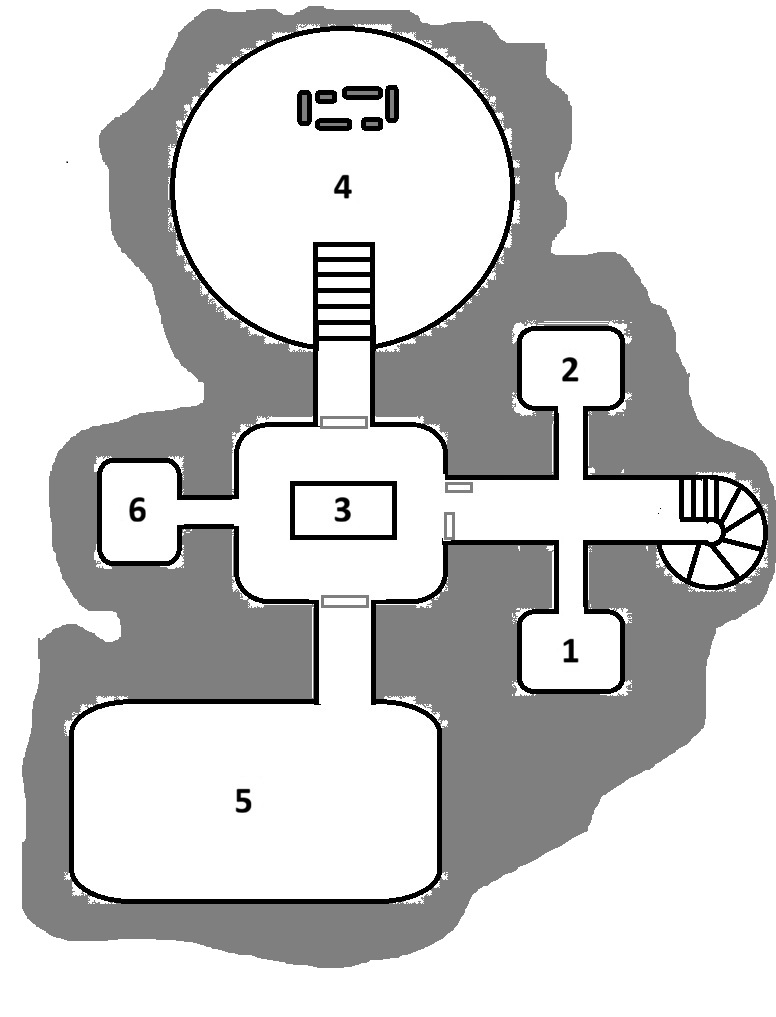
The basement does not appear on the plans provided by Vändel, but when the investigators access the stairwell, it is hard to miss the locked and heavily reinforced door that hides the spiral stairs leading down. The stairs are of rough-hewn stone and seem to descend much further than just one level down. Thick, rubberized cables snake down the uneven steps, making footing treacherous. As the investigators descend the worked stone of the house´s foundations gradually transition into solid stone. At the bottom of the stairs a narrow hall chipped out of living bedrock leads up to a set of metal double doors, one of which stands ajar. This mine-like subterranean space is illuminated by a row of naked lightbulbs hanging off a single black cable. A muted rhythmical mechanical sound can be heard, like a car engine idling in the distance. The overhead lights flicker now and then.
This underground space is not part of the original layout of Villa Höggarn. Weir excavated it himself, with the help of undead servitors and according to plans he wrested from the ghost of a long-dead mining expert.
1. Battery room
A very narrow passage leads into a small side chamber, in which stands a cluster of large lead accumulator batteries. An electrical hum can be heard on the edge of hearing, and the air stinks of sulphuric acid. The batteries are Weir´s last-ditch defense to keep the ghost containment devices active in case of a power outage. Looking closely at the various dials and gauges reveals that this primitive power bank has about 10% charge left.
2. Storage chamber
A mirror twin of the battery room, this chamber is used as a storage area. Two dusty, recently disinterred coffins rest on trestles in the middle of the room, and in one corner lay the jumbled bodies of the two zombie servants Weir kept around for the heavy lifting. They are now both truly dead, the animating magic dissipated with the necromancer´s death.
3. Laboratory and storage room
Beyond the metal doors is a small cubical space, with a large metal table in the middle. Wooden crates and cabinets line the walls. A powerful-looking operation room light descends from the ceiling on a cantilevered arm, illuminating the worktable. On the right and left are heavy, convex metal doors with a locking wheel in the middle, vaguely reminiscent of bulkhead doors in a submarine. Both doors are closed and sealed but not locked. Straight ahead is a smaller, regular wood door with a simple latch. Several thick power cables snake along the floor and drape across the ceiling like lianas, coming from the corridor and splitting up before vanishing into openings next to the doors on either side.
The shelves around the room are filled with the paraphernalia of the necromantic arts; glass bottles of varying sizes, copper wire and glass-etching tools. In some of the crates are neatly packaged bones – remains ready to be imprisoned in glass, raised and interrogated.
On the table lies the broken remains of a large glass bottle amidst a strange grey dust, small pieces of bone and a skein of tarnished copper wire. The shards of glass are intricately etched with lines of arcane symbology. A hand-written label attached to one of the larger shards says “Specimen 138. Anne Teschen, Vienna. 1879-1892. Poltergeist”. Upon closer examination, it is obvious the glass was broken from the inside.
4. Ogrun´s burial chamber
A short, narrow passage leads from the storage room into the chamber where Weir reassembled Ogrun´s tomb shortly after the Rönninge incident, and where he has kept her imprisoned for over twenty years.
This circular, domed chamber is excavated a level deeper than the rest of the subterranean complex. The corridor opens up about halfway up the south wall of the chamber, and a rickety staircase leads down to the uneven floor. Thick cables spill out over the floor. Ogrun´s tomb is located up against the far wall, surrounded by protective circles and ringed in contraptions resembling Tesla´s generators that spit sparks and miniature lightning. The air reeks of ozone. Warding runes and unpleasant pictographs are daubed all over dark stone walls, and intertwined, concentric rings of protective wards are layered around the tomb itself. The designs cause vertigo, disorientation and a sense of repulsion to anyone studying them too closely.
The tomb itself is a rough box-like cluster of standing stones surrounding an open burial pit in which Ogrun´s skeleton can be seen curled up in a fetal position at the bottom; each crumbling bone wrapped in a skein of copper wire, connected to a stack of electrical equipment nearby. If the investigators have done research on the Rönnerås excavation, they may recognize Ogrun´s tomb from old photographs.
5. Spirit containment chamber
The bulkhead door leading into this room is exceptionally sturdy and inscribed by intricate occult symbols. The room itself is largely empty. A series of shelves on the far wall hold a large number of glass bottles and jars, varying in size from a perfume bottle to large carboys. The containers are intricately etched in eldritch patterns and emit a weak, ghostly glow. Some of the larger bottles are wrapped in copper wire and connected to electrical conduits running along the ceiling overhead.
To the left side is a man-sized glass case in which a very old and crumbled skeleton rests on a bed of gray sand. The bones and the large war axe resting on the corpse´s collapsed ribcage are all entwined in a skein of copper conduits. The weapon especially– which looks strangely new compared to the rest of the contents – is almost completely covered in a spider´s web of electrified wires. A rusted helmet, bits of chainmail and various other Viking-era grave goods are scattered around the skeleton. This is Anund´s mortal remains.
On the right is a smaller, but seemingly more heavily reinforced class case containing an old, worn wooden bucket with the lid nailed shut. On top of the lid lies a pair of rusting old shepherd´s scissors. The glass barrier appears almost frosted by all the fine occult wards etched into it, and the whole contraption is connected to several heavy-duty electrical cables. The occasional spark fly, and – if the investigators listen closely – they can hear a high-pitched hum emanating from the bucket itself. The Myling is trying to break loose.
6. Incinerator room
A small cavern where a large iron furnace almost completely fills up the space, the flue disappearing into a hole in the ceiling. A convenient way for a necromancer to dispose of surplus remains and coffin material.
The Undead
At the time of his death, Weir had about ten ghosts imprisoned in the basement. Most of these are weak spirits that are unable to influence the physical world much beyond sendings of sounds, cold shivers and the occasional glimpse in a mirror. In short, all they can do is to frighten. One of the spirits, that of a teenage girl, is a little more powerful and can manifest telekinetic attacks in a poltergeist-like fashion – throwing objects, closing and barring doors and suchlike.
The remaining three are of a considerably more powerful class, a type of undead which in Swedish folklore is called a gast. These – Ogrun, Anund and the Myling – are able to manifest a physical form to interact with and possibly harm the investigators. If provoked, they attack with superior physical strength and a life draining ability. They are somewhat intelligent and can sometimes be bartered with.
All gasts are closely tied to their remains and their place of interment, and the only way to permanently harm a gast is to destroy its resting place, which can happen in a number of ways. Anund the Draug, for example, is tied to a piece of weaponry in his grave offerings. The Myling, dragging around the bucket she was buried in, can only be dispelled by means of giving it a Christian name and have an ordained priest perform a baptism ceremony before being buried in on consecrated land.
The restless undead all share a hatred for Weir, who has kept them away from their rest and tortured them for information, Not particularly friendly to the living in their habitual state, years of abuse and imprisonment has made them downright bloodthirsty towards anyone that enters their realm. Ogrun, retaining much of her personality even after death, is a possible exception – but only if the investigators play their cards right.
Ogrun
Ogrun lived sometime around 1200 BCE, among a semi‑nomadic tribe in the vast primeval forests along the border between Småland and Skåne. Even in life she was a powerful spirit‑worker and a figure of power among her people. During the supernatural war of extermination that preceded the Bronze Age collapse, Ogrun used her arcane abilities to lead her followers to safety and shield them while wild magic laid the world around them in ruins — though at the cost of her own life.
She was buried in a burial mound at Rönnerås on Öland, where she slumbered until the 1903 excavation broke into her crypt and caused her to rise again as a powerful physical undead — a gast.
In her newly awakened fury she drained the life from every member of the expedition except Weir, who, using poorly understood arcane knowledge and electricity, managed to subdue the raging undead. Realizing her potential, he kept her imprisoned ever since, torturing her to extract her magical knowledge and forcing her to summon and control other spirits. The deaths of the Rönnerås expedition were officially explained as anthrax spores disturbed by the excavation.
Because a gast is bound to its crypt, Weir painstakingly relocated the entire burial chamber from Rönnerås to the cellar of Höggarn, piece by piece. Ogrun’s physical remains lie arranged in a stone‑lined pit in the earthen floor of Weir’s cellar, wrapped in copper wire and connected to a power source which Weir could manipulate to control the mighty gast — at least as long as the electricity remained active.
Ogrun manifests as a short, muscular woman in her mid‑40s with weathered features and an intense, dark gaze. Her hair is raven‑black with streaks of gray, braided in an intricate plait. Her skin is covered in spiral tattoos, and she wears a mantle woven from grasses over a simple linen tunic adorned with sewn‑on seashells. Bracelets and necklaces made of teeth — both human and animal — rattle when she moves. If she becomes agitated or annoyed, she reverts to her gast form, her skin darkening and eyes becoming empty silvery orbs.
Though undead, Ogrun retains much of her original personality. She is intelligent and capable of reason. The long years spent with Weir have allowed her to communicate in modern Swedish. She has two goals in her undead existence: to take revenge on Weir (who is dead, but that is no obstacle for a spirit‑worker), and to return to her eternal rest. As a schooled shaman, her continued existence as an undead is unnatural and deeply offending to her. She wants it to end at any cost.
If the investigators offer to help her fulfill these conditions, she is willing to help them find what they seek in the house, undisturbed by the other spirits. As a gast, she exerts dominance over all weaker spirits.
If the investigators do something truly foolish — such as insulting, threatening, or physically attacking her — she will inevitably kill them. No mortal can withstand her without access to extremely potent magic. Gasts are formidable foes, and Ogrun is more powerful than most.
If the investigators play their cards right, Ogrun can exorcise the other spirits (except the myling) and even help them find what they are looking for in the manor. The most constructive solution is to promise Ogrun that they will retrieve Weir’s body so she can summon his spirit and exact her revenge. If they bargain with her in a respectful manner, she will help them extract the code for Weir´s safe before she ends his existence.
After Ogrun has taken her vengeance on Weir’s spirit, she will ask the investigators to bury her in a nearby burial mound, preferably the Kungshögarna. If they assist her, she can provide clues to the location of the Black Horn and reveal that it should be returned to its rightful owners — the trolls of Trollegater.
“There is something here, in this city. Something that disturbs the eternal rest of the dead. A powerful artifact that, in the wrong hands, can bring immeasurable torment and destruction. And immortality, for those that seek such things”
Knowledge Checks
- Moderate Gasts are higher undead capable of taking physical form. They exist in several variations, but the most powerful arise when a skilled magic‑user is summoned from the grave. They are intelligent and can — sometimes — be negotiated with.
- Hard A fundamental condition for a gast’s undead existence is that it has a purpose it must fulfill. The only way to permanently return a gast to eternal rest is to help it fulfill that purpose. Offering such help can be a bargaining chip when interacting with the creature.
The Myling
An illegitimate, unbaptized baby girl killed at birth in the 1600s and buried beneath a granary floor in Bergslagen. When Weir found her, her remains lay in a small wooden bucket with a pair of scissors placed on top.
The myling is one of Weir’s mistakes — the moment he learned not to summon what he cannot later put down. The myling is extremely powerful, hateful, and aggressive. There is no necromantic ritual powerful enough to exorcise her. Only through Ogrun’s necromantic abilities was he able to control her and keep her imprisoned. The box containing her remains, wrapped in electrified copper wire, is imprisoned behind the same wards as Ogrun. Only the presence of the more powerful gast shaman keeps the Myling from breaking free.
The child-gast manifests as a horrifying, flickering infant, wrapped in billowing white cloth and dragging behind her the wooden pail she was buried in. Like all gasts, she is bound to her physical remains, so she literally drags around her own prison. Her head is visibly deformed from the fatal blow. It attacks by gripping the victim in a death‑clutch and draining its life force — all while screaming and chattering like a knife edge dragged across glass.
Knowledge Checks
- Easy Mylingar — the restless spirits of unbaptized infants or aborted fetuses — are dangerous opponents. The broken promise of a life fills them with a rage that fuels immense spiritual energy. Summoning the spirit of a small child is a mistake a necromancer rarely lives to try twice.
- Moderate A myling cannot be exorcised. Its bones must be laid to rest in consecrated ground after a Christian baptism ritual in which the myling is given a name.
The Draug
Anund Gråfäll, a Viking chieftain who ruled the region around Nödinge‑Nol in the 800s. He was buried in an elaborately decorated grave with a wealth of grave goods. However, a völva from a rival tribe placed a curse upon him, and he rose after death as a draug — a lesser form of gast.
Anund was never a great warrior nor a brilliant mind, and a millennium of solitude in the darkness of his burial mound has taken its toll. He manifests as a ragged, gray, skeletal figure in a helmet and rusted chainmail, giving an impression of confusion and sorrow. Even in life, he was unusually tall, over 7 feet. Pale lights, like two full moons, shine in his empty eye sockets. His battle‑axe, however, remains sharp and well‑polished; somehow it appears almost more real, more fully manifested, than Anund himself.
Like all gasts, Anund can shift between physical form and a sickly yellow mist that seeps under doors and through keyholes. He can only attack physically in his material gast‑body, but he is slow and clumsy enough that his attacks can be avoided with relative ease. He can only be harmed by steel or iron, and when wounded he bleeds yellow vapor. If his gast‑body is sufficiently damaged, he will dematerialize into mist and cannot take physical form again for some time.
Knowledge Checks
- Moderate A peculiarity of draugar is that their soul is bound to their weapon — in Anund’s case, a battle‑axe. If the weapon is destroyed, the draug dissolves as well.
- Moderate Anund Gråfäll is considered one of the saga‑kings from the Prose Edda, where he is referred to as “Anund the Simple”.
The Spirits Attack
As the investigators search the manor, the ghosts begin to free themselves from the bonds with which Weir has shackled them, and they gradually start to make themselves known. Since the weaker spirits free themselves first, the manifestations will initially be small‑scale: distant laughter, footsteps, and occasional glimpses of indistinct shapes in mirrors and dark corners.
Over time this shifts into poltergeist activity, where doors slam shut and small objects are hurled at the investigators by invisible forces. As a crescendo, music suddenly begins to stream up from the ground floor as the skeleton orchestra awakens, but it falls silent immediately when any curious investigator approaches the ballroom.
Once the investigators have been drawn in, the poltergeist will tear loose the anchorings of the enormous chandelier in the lounge and try to crush one or more of them under it, unless they are able to evade. As a last resort it will possess the dead body in the library, puppeteering it to fling itself against the investigators, while the skeleton orchestra plays a wild and insane fugue on violin and piano.
Once the investigators enter the basement, the poltergeist attacks subside. After all, there are things down here even a poltergeist fears. However, it will use the dead Ahnenerbe agent to block off the stairs,
In the basement, Weir has installed a bank of lead batteries as a last line of defense to keep the spirits from escaping in case of a power outage. However, after about two days without being topped up from the diesel generator upstairs, the voltage is running dangerously low. As the power sputters out, a compact darkness descends, and the investigators can hear glass shattering as the undead break free.
Anund the Draug breaks free first. In his mist form, he seeps into whatever room the investigators are in, materializes, and attacks them with slow, clumsy swings of his battle axe. He is very powerful, but slow – and he telegraphs every swing. Strangely enough, his attacks seem almost absent-minded, as if distracted. At times he pauses, just staring into space for a moment, almost as if his heart is not in it.
The myling frees herself last, and against her the investigators have no defense. She is a manifestation of rage and horror, and they possess nothing even close to the magical protection required to withstand her.
When the sharp crack of shattering glass rings out from her prison, Anund stops dead in his tracks. He turns his head toward the sound, a look of pure panic twisting his withered features — and then he flees, dissolving into mist as he beat a hasty retreat.
An oppressive, supernatural dread settles over the investigators as the child‑revenant climbs free of her prison. The most primitive parts of their souls recognize a predator, and they are prey. The temperature plummets; frost creeps across the damp stone walls, and their breath crystallizes in the air. Some form of sanity check is in order.
The metal doors hold for only a moment before they begin to buckle inward, twisting like soft clay under an invisible force. A high, piercing scream erupts from the darkness — a sound so sharp it bursts flashlights, ruptures eardrums, and sends blood trickling from noses.
The undead infant moves in unnatural, jerking bursts, deceptively fast, flickering from one position to another as if reality cannot quite keep up with her. Behind her, bound to her form by smoky chains, she drags the old wooden pail in which she was buried.
It is advisable to let Ogrun save them just as they are about to be torn apart by the Myling’s blackened little claws. If they stand their ground, they will inevitably die. Rattling her teeth bracelets and crooning a low, guttural tune, Ogrun commands the Myling to revert back to inert skeletal remains. Reluctantly, snarling and screeching, the little gast climbs back into its bucket and dissolves into dust and tiny, broken bones. Ogrun will then ask the investigators why they are there. Temporarily saved, this is a golden opportunity for them to make a bargain.
Striking a deal
If the investigators address Ogrun directly and respectfully, she will hold off any other attacks. She is willing, at least temporarily, to listen to what they have to offer. Ogrun´s goals are simple – she wants revenge against Weir and to return to her eternal rest, in that order. The fact that her tormentor is already dead is only a small inconvenience to a gast as powerful as her.
To gain Ogrun´s support, the investigators must promise to obtain Weir’s earthly remains. Intuiting their own goals, she will sweeten the deal by offering to extract the combination for the safe from the resurrected necromancer.
Retrieving Weir´s remains
To appease Ogrun, the investigators must bring Weir´s dead body back down to her in Villa Höggarn´s basement. However, the earthly remains of a powerful death-aspected magus such as Weir is a dangerous object, prone to rising again as a revenant or becoming possessed by various otherworldly spirits. A human body, as one might imagine, is used to being possessed – by the inhabiting soul – and when the original occupant leaves, another may move in to reanimate the dead flesh and cause trouble.
Therefore, it has been seized by the Order of the Silver Cross, an organization within the Swedish state church, which specializes in securing dangerous artifacts, texts – and corpses. In fact, the burial rites utilized by the Church are in place to consecrate even a normal corpse, ushering the soul into the afterlife and preventing anything supernatural from repurposing the remains.
The investigators probably already know that the body has been moved, but not necessarily by whom. Questioning Coroner Tingström, perhaps even waking him up in the middle of the night, may give them a pointer on where the body has been taken.
The Silver Cross Repository
In a secluded corner of Uppsala Old Cemetery sits a low, utilitarian building known colloquially as St. Sigfrid’s Chapel. This is the site of the so‑called Repository, a facility where the Silver Cross stores dangerous artifacts and imprisons the restless dead. A low wrought-iron fence and a dense yew hedge surround the bunker-like brick structure. A little steeple on top makes it look like a toy-sized church.
The casual observer may think this the, somewhat unusual, tomb of some long-extinct wealthy family and wonder no further of it.
The windows are narrow slits set high up on the walls and the door is a heavy, black iron affair with a solid lock. However, the building is old and breaking in is not particularly difficult.
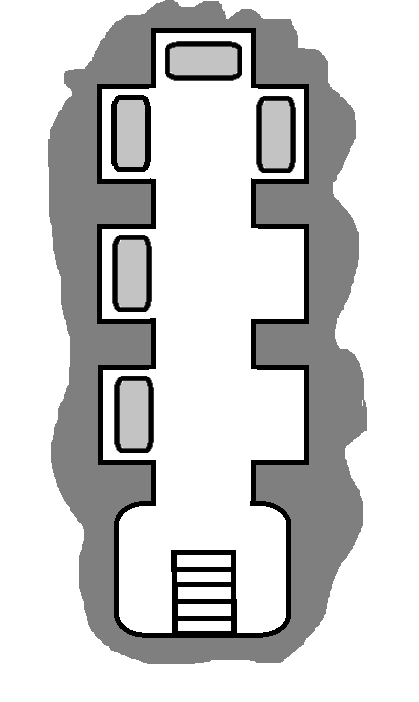
Once through the door, they enter into a bare, whitewashed room. The walls are covered in symbols and the occasional phrase in Latin, but - strangely enough – no Christian iconography. In the middle of the floor is an iron grate covering a narrow staircase leading underground. Footprints in the dust lead up to the trapdoor, and back again.
The steps lead down into a vaulted brick chamber, from which a broad passage leads off into the darkness. In alcoves in the walls of this corridor, coffins on catafalques are placed, four in total. All of these are heavy affairs, fashioned from lead and wrapped with chains and occult sigils – and they all contain the corpses of dangerous magicians, in uneasy repose.
Weir´s coffin is at the back of the passage, not yet placed in an alcove. It sits on wooden trestles, and the lead seals appear freshly minted. Dragging the corpse out while still in its monstrous lead container is not feasible, but luckily the wards are designed to keep something in rather than tomb-robbers out. The magical seals around the coffins edge are easily broken by mundane chisels or other tools, and within, resting wrapped in a cotton sheet stitched with occult designs, lie the dead necromancer. The wizened old man is surprisingly easy to lift and carry out of the tomb.
Complications
While Silverkorset does not have a permanent guard posted at Uppsala Gamla Kyrkogård, making noise or lingering too long is bound to attract attention sooner or later. Letting the investigators get into a firefight with heavily armed warrior-priests is probably not a good idea, narratively – but having a Silverkorset patrol show up as they are loading the dead body into a van can incentivize the players to get out of Dodge and move the story along. A few bursts from a Tommy gun ricocheting off the gravestones should do the trick.
If the investigators did not bring a vehicle, they´ll have an interesting trek through the streets of Uppsala, in the small hours and with a stolen corpse in tow. There is a groundskeeper´s shed nearby where a wheelbarrow can be commandeered, if needed. A little bit of comedy at this point can be a powerful narrative move.
Return to Villa Höggarn
Once the Investigators have delivered Weir´s dead body to the basement, she will forcibly return the soul to the cold flesh. The dead man moans and twitches, before being jerked upright. The reanimated Weir fights the compulsion with every step. He tries to order the spirits like he was once able to, but – in the end – he is forced to surrender the codes to his safe before Ogrun and the rest of the ghosts swoops in on him. The old man is yanked into the air as if by an invisible hand and pulled inexorably towards Ogrun. Now, for the first time, the terrible old man suddenly shows real terror, clawing desperately at the air as Ogrun, reverting into her gast form, steps in closer for a gast kiss.
Ogrun calls down a pale astral fire which — amid great agony — consumes the corpse and annihilates Weir’s soul in the process. In some strange way, he is erased from existence, like he never really existed at all. All that is left is floating ash and a greasy soot stain on the floor. The oppressive aura around the old mansion fade, as if cleansed. A great wrongdoing has been rectified. Balance - the natural order of things - is restored, and the dead are no longer compelled to walk among the living.
Resolution
Once Ogrun has had her revenge, her reason for remaining in an undead form is gone, and she starts to fade. She will deal fairly with the investigators and thank them.
Before going, she sets the other ghosts free. Anund, his withered face splitting into a grin, lets the battle-axe - to which his soul is bound – fall to the floor. It settles with a heavy clang, then rusting and warping in seconds, as the old Viking chieftain finally passes to the other side. The air fills with the clinking of heavy chain and the squeaking of wheel axles as he dissolves.
The Myling, Ogrun explains, must be buried in consecrated ground after a baptism ceremony has been performed. She leaves this task to the investigators, with assurance that the child-gast will remain dormant in her pail until such steps can be taken. Ogrun herself asks to be reburied in a suitable Bronze Age mound, for example the mounds at Gamla Uppsala.
Before Ogrun fades away, she will dip her finger in Weir´s ashes and inscribe a stylized eye on a randomly selected character´s forehead. This character will dream of Okku the next night.
The contents of Weir´s safe
With Weir and the haunts gone, the investigators are free to open and go through the contents of the massive safe upstairs. Behind the impregnable door lies – surprisingly little. The interior cavity is small and divided by two metal shelves. On the top shelf lie, side by side, three nondescript notebooks, marked I, II and III. This is Weir´s research journals. On the bottom shelf, beside a velvet folder, lies a single, faded daguerreotype. Everything looks suspiciously neat, almost arranged, as if Weir left these objects here for someone else to find.
Weir’s Research Journals
Weir’s research is meticulously documented in a numbered series of three gray notebooks of the type used by laboratory assistants. His handwriting is obsessively neat, and it is clear these are restructured and condensed field notes. The books are numbered thematically:
1. The First Book
The book opens with a stanza from Borellus’ Biblioteca Chemica (1654):
“The essential Saltes of Animals may be so prepared and preserved, that an ingenious Man may have the whole Ark of Noah in his own Studie, and raise the fine Shape of an Animal out of its Ashes at his Pleasure; and by the lyke Method from the essentia... incinerated.”
The book then describes Weir’s method for summoning, binding, communicating with, and subjugating the dead. One section outlines different types of spirits, their peculiarities, and how best to handle them. A large portion of the book details Weir’s technique for imprisoning spirits in glass bottles using electrical fields and binding symbols, where they can be subdued and their knowledge extracted. Electrical wiring diagrams and technical terminology are interwoven with occult symbology and Latin‑sounding invocations.
The final pages contain a warning in which Weir advises against summoning the spirits of unbaptized or stillborn children, who return as extremely powerful, uncontrollable, and malevolent ghosts known as mylingar. He also warns against attempting communication with the spirits of arcane practitioners. The book ends with a cryptic quote:
“Doe not call up that which you cannot again put downe.” — Unknown
An investigator who studies the book in depth (requiring 1D6 weeks and access to a library for reference material) may potentially learn spells for summoning and communicating with the dead. The book also contains the sealing spell “The Wizard’s Lock”, which protects a closed space from all magical influence.
2. The Second Book
This book is an inventory of knowledge Weir extracted — under torture — from various spirits. It consists largely of interrogation transcripts cross‑referenced with earlier sessions involving the same entity, as well as similar interrogations of other spirits. Weir appears to have had multiple goals: acquiring occult knowledge for personal use, and locating ancient finds and artifacts that could be sold for large sums on the black market.
Communicating with the dead seems to be a painstaking process; they are forgetful, they lie, they resent being summoned from their eternal rest and they are often frustratingly vague. Information frequently needs to be double‑checked and cross‑referenced before it becomes practically useful.
There are also indications that Weir collaborated with a group of like‑minded, likewise shunned, individuals. Among other things, the notes show that Weir corresponded for many years — exchanging both knowledge and mirror‑imprisoned spirits — with a certain Eastern European Count A.
The book concludes with an inventory list of the spirits Weir has had in his possession. As far as can be determined, around ten entities were present in the house at the time of Weir’s death (see the section The Undead).
3. The Third Book
The third book is an account of all information Weir gathered concerning a powerful magical artifact he calls The Black Horn. It appears to have been his Holy Grail — one he never managed to find.
The book begins with a rewritten and modern‑Swedish translation of “Accounts of Dionysus Bureus concerning the Battle of Kisa and the remarkable events that preceded it”, which will be significant in the next act. This is followed by a biographical record of a certain Jöns Jakob Baselius, who seems to have possessed the horn after the Dacke Rebellion around 1540. Strangely, the chronicle of Baselius continues all the way into the 1700s, where indications suggest he brought the artifact to Uppsala and hid it there after using its power to defeat an evil sorcerer somewhere in the forests of Småland.
Baselius (or someone very much like him) briefly resurface in the accounts of an incident in the early 1800´s concerning a conflict between townspeople and rural folk in the vicinity of Rimforsa in Östergötland. After this, Baselius apparently disappears from history and is never heard from again.
It seems impossible these stories feature the same man, considering the time span of almost 300 years. Perhaps several men with the same name, but living centuries apart, has been mixed up in this account?
The Hodmimir Photograph
A framed sepia daguerreotype depicting four men and one woman standing before an upright stone in what appears to be a glade in a pine forest. At the bottom of the photo, in white text: “Okku’s seite, Vittjåkk, 1915.”
On the back, written in ink: “Hodmimir’s Holt”, followed by a list of names: Karl‑Ulrik Vändel, Otto Weir, Efraim Röde, Peter Paulsen, and Eliza Häger.
The investigators will indeed recognize a very young Vändel.
The photo has no particular significance for this adventure but serves as a clue for events later in the story.
Knowledge Checks
- Easy Vittjåkk‑Akkanålke is a forested low mountain outside Arvidsjaur.
- Easy Hodmimir’s Holt (or Hodmimir’s Grove; from Snorri Sturluson’s Prose Edda) is an unspecified location in Norse mythology where the last living humans — Líf and Lífþrasir — survive Ragnarök and repopulate the ruined world.
- Moderate A seite is a cult site associated with traditional Sámi paganism. Okku is an obscure Eastern Sámi deity or guardian spirit often associated with the epithet “the old one.” Stones carved with a stylized eye are attributed to Okku. From an intellectual‑historical perspective, likely a Sámi iteration of the All‑Father — Odin or Wotan. Traditional offerings of salt and tallow are sometimes seen in the extreme north, even to this day.
“Ye Accounts of Dionysus Bureus”
This is the original manuscript from 1542, the one transcribed into modern Swedish by Weir, and what Vändel sent the investigators here to find. Densely written on parchment, it is very fragile and therefore kept in a protective velvet case, each sheaf separated from the next by a square of silk. Some of the pages seem to have been crumbled up at some point, probably by the irate King Gustav. The case is held closed by a silk ribbon into which a small envelope is tucked, bearing a wax seal with Weir´s motto : Mors Tantum Initium Est. Inside the envelope is a card, reading:
“To the finder of this document.
In the case of my demise – which I assume has occurred if you are reading this – a clue to finding the Horn is indeed hidden within the pages of “The Accounts of Bureus”. However, the information is obscured in a simple, but frankly brilliant, way. I sense the hand of Baselius in this. With great difficulty, I managed to transfer the enchantment from Bureus´ original to my modern Swedish translation.
It is best if you tell Vändel nothing of this. No doubt he has sent you here to retrieve the original manuscript, which is now inert, useless. Its magic drained. Just the poorly written ramblings of a scared, stupid man. Give it to him, but keep the rest, either for yourself or someone you find worthy. Remember, Vändel and the rest of the Faculty cannot be trusted.
If you wish to pursue the Horn, go to the Red Moon Inn on St. Lars´ Street and find the proprietor, Mme. Corvus. Ask her for the bottle of Absinth I left there to be brought into the reading room. Have a glass and read the Accounts. The path will make itself known.
Good luck.
Otto Weir”
Aftermath
Delivering the manuscript to Vändel
When the – probably slightly bedraggled – investigators arrive at Gustavianum, early on Monday morning, to deliver the manuscript, Vändel will appear more thoughtful than happy. He is surprised, even though he will not admit it, that the hastily assembled crew could actually pull this heist off. Apparently the investigators are more capable than he calculated, and he doesn´t like being wrong. He will look at the investigators with a bit more respect in the future, and not only as facilitators of future missions. Competent people must be watched.
Sometimes brilliant but linear minds like Vändel´s can trip themselves up. He is completely fixated on the original document and the clues it hides and will not even consider – or inquire after – the other documents. If the investigators choose to keep the letter and notebooks for themselves, they can do so without risk – for now.
Burial duty
- Laying the Myling to rest
- Burying Ogrun
Tying off loose ends
The Order of the Silver Cross is, unsurprisingly, not amused by the break-in at the Repository and, of course, understands that the incidents at Villa Höggarn the same night is somehow tied to the trespassing and tomb robbery. Vändel can help mediate, and some appeasing gestures must be made. If any or all of the investigators were identified, they can expect to be treated with quite intense suspicion in any future dealings with Silverkorset.
Ahnenerbe, particularly the local commander and magus Herman Wirth, has been seen to publicly break the Accords of Uppsala by calling down a magical thunderstorm on another practitioner within the city limits. While the Concilium themselves, not particularly fond of Weir, might have let the matter slide, the Accords themselves do not. Knowing this, Wirth and his entourage hastily vacate the Ahnenerbe facilities in Uppsala and beats a retreat to Berlin within the week. The Nazi delegation is not completely out of the picture, but their most powerful player is out of the game - for now.
The Ghost Fever
One or two days after the events at Villa Höggarn, the investigators will experience a bout of flu-like symptoms; fever, night chills, muscle ache and vivid nightmares. The human body is not constructed to deal with exposure to arcane energies, and the Ghost Fever, a form of occult radiation sickness, is something all newly awakened will experience. It marks a point of transition, the start of transformation into something more (and less) than human. An occult seed has been planted, and will eventually flower into arcane abilities – but how and when this happens is up to the investigators.
The Okku dream
Ogrun metaphysically branded one of the investigators with the mark of Okku, an old and hoary deity aspected to the cleansing fire and guiding of souls into the afterlife. Undeath and necromancy is an affront to Okku, and anyone instrumental in freeing such unfortunate souls from bondage can expect Okku´s approval. The marked investigator will dream of Okku a few nights after the events at Villa Höggarn, probably while in the throes of the Ghost Fever.
The player is given the following handout:
“In your dream, you find yourself standing on a dark moor. Low hills rise around him, strewn with ancient stone cairns crouching in the mist. A heavy, suffocating haze lies over the land, muffling both sound and thought. Bracken and heather cover the slopes. A faint drizzle falls. It is cold.
From within the fog comes a song. A monotonous, droning chant, not unlike Mongolian throat-singing, its vibrations felt more than heard. It draws nearer, slowly.
The mist parts.
A colossal six-wheeled wagon rolls into view. It resembles a mobile Gothic cathedral, or an ancient stave church set upon wheels, its dark timber steeped in soot, salt, and time. The wagon is pulled by hundreds upon hundreds of the dead, shackled to the driver’s perch with thick, rusted chains that bite deep into their rotting flesh. With rotted throats they sing their guttural hymn, an eternal work-psalm for the dead. They groan and strain, ad the great wagon rumbles forward.
You recognize one of them. Anund Gråfäll, the cairn-wight, at least a head taller than the others, his features still carrying traces of defiance and the grave-mound’s wrath. His chain is thicker than the rest.
The wagon rumbles to a halt alongside you. On the driver’s perch, beneath a high arch of darkened wood, sits the coachman.
A squat figure wrapped in a voluminous bearskin cloak, the bear’s head forming a hood. Broad, knotted hands hold the reins with effortless weight. A short grey beard and a coal-black pipe jut from the shadows beneath the hood. Within those shadows gleam a pair of wolfish yellow eyes.
This is Okku, the Old One. You know it instinctively.
The god of salt and fire. A Karelian local deity, whose name is whispered in Topelius’ sources for the Kalevala — mentioned, but never fully described. He who rules over burning and consuming, over the ash that remains after the offering.
Okku reaches down with his broad, brutal hand. Blood is caked under the long fingernails. Primitive spiral tattoos cover his skin. He does not smile. His strength when he pulls you up next to him on the driver´s perch is incredible, unnatural. He does not let go, looking at you intently with his animalistic eyes. Then he shifts his grip, locking one of those giant paws around your neck. In the other one, a small, glittering flint blade suddenly appears. And he plunges it into your left eye socket, levering out the eye.
The pain is white and absolute. He throws the bleeding lump out into the sea of undead figures in front of the wagon. You can’t move a muscle, just watch as Okku turns that blade on himself, and removing his own left eye in the same manner. Without a word, he presses it into your - now empty - socket, replacing your eye with one of his own.
The dream fades to black. You wake up screaming, finally able to. The room lies still and silent. The worst migraine you´ve ever felt bores into the left side of your face.
You stagger over to the washstand and look at your reflection in the mirror. There is no blood, no wound, but the left eye is the yellow color of honey. A wolf´s eye.”
The story continues in “Interlude I: The Accounts of Dionysus Bureus”



Not Registered Yet? No problem.
Do you want Strolenati super powers? Registering. That's how you get super powers! These are just a couple powers you receive with more to come as you participate.
- Upvote and give XP to encourage useful comments.
- Work on submissions in private or flag them for assistance.
- Earn XP and gain levels that give you more site abilities (super powers).
- You should register. All your friends are doing it!
? Responses (2)
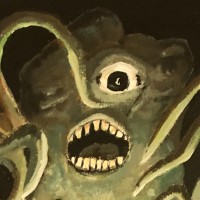
This is excellent - no half measures here! Love the inclusions of the maps!
Thank you, sir. More to come soon.